
This month I have the bittersweet
privilege of giving God our profound thanks for the ministry of
Bishop Garth Counsell as Bishop of Table Bay, and also of saying
farewell to him and Marion on his retirement from that position.
Showing posts with label Diocese of Niassa. Show all posts
Showing posts with label Diocese of Niassa. Show all posts
Monday, 27 May 2019
Ad Laos - to the People of God - June 2019
The text of Archbishop Thabo's June Ad Laos, also to be published in the Cape Town diocesan newsletter, Good Hope:
Monday, 6 May 2019
Mission of Mercy, Hope and Solidarity to Mozambique - A Report
MISSION OF MERCY, HOPE AND SOLIDARITY TO MOZAMBIQUE (LEBOMBO AND NIASSA DIOCESES) AFTER CYCLONE IDAI
A report for Archbishop Thabo Makgoba by Mrs. Matlotlisang Mototjane, Provincial Executive Administrator and a former Manager in the Lesotho Disaster Management Authority.
Download here (PDF-15 pages) >>
A report for Archbishop Thabo Makgoba by Mrs. Matlotlisang Mototjane, Provincial Executive Administrator and a former Manager in the Lesotho Disaster Management Authority.
Download here (PDF-15 pages) >>
Sunday, 14 April 2019
Displaced and living "like wild animals' – a neglected place where only the Church is visible
 |
| Delivering supplies |
Archbishop Thabo travels to an isolated area in the Diocese of Niassa where there are no NGOs, no post-Cyclone Idai assistance and where the plea is for "comido" (food):
DAY THREE: At 6:40 am Bishop Vicente gathers eight of his clerics and church wardens to join us for Morning Prayer. We are later joined by two cathecists, and afterwards pay a courtesy call on the district governor, as has become the norm.
Then we drive to the marketplace to buy seed and rice, as we did last week in Sofala Province when I visited the Diocese of Lebombo. As in Sofala, I learnt that solidarity has to be accompanied with food. The marketplace is busy and when the vendor realizes we are buying in bulk and for what cause, he gives us a good discount.
Friday, 12 April 2019
Bishop McKenzie’s grave has drowned

DAY TWO: After breakfast and Morning Prayer – and reading Jeremiah 28:17ff – at our Quelimane guest house, I return to my room to catch up and study the disaster intervention plan from Niassa Diocese. As intimated yesterday, this diocese has dealt with flooding, food and health disasters before. They are amazingly well organized and deserve all the support they can get.
Our departure to a district 30 km outside Quelimane city is delayed because of past conflict in the area, which means we need special permission to travel and a dispensation from the Governor. We get this and it commends us to the three district governors whose areas through which we will travel.
Thursday, 11 April 2019
Visiting the Diocese of Niassa in the wake of Cyclone Idai
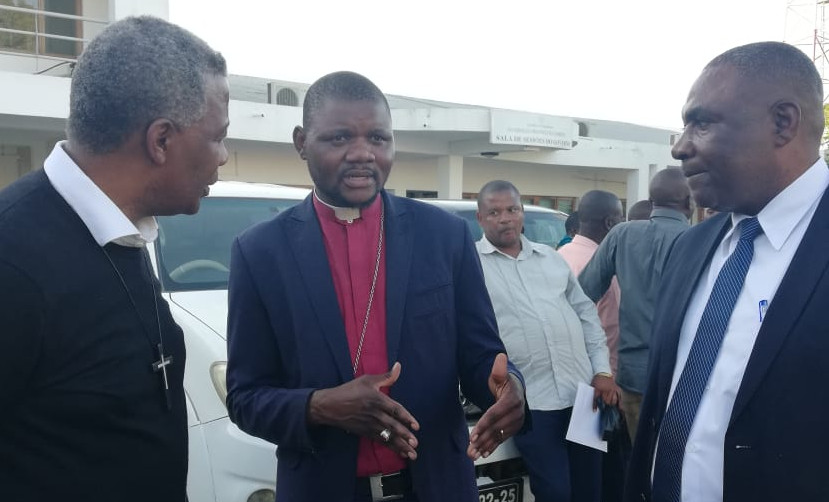 |
| Bishop Vicente gives a briefing on the visit |
DAY ONE: The alarm rang at 4:20 and by 5 am Uber is here to pick me up and take me to Cape Town's airport, where we board for Johannesburg at 5.50. Heavy mist delay the flight – fortunately all flights, and we were in Maputo by 11:20. Along the way we meet Bishop Zipho Siwa, the Methodist Church's Presiding Bishop, and his team, who are also visiting congregants affected by Cyclone Idai. Boarding for Quelimane is scheduled for 11:30 but we finally depart at 14:15 and while waiting I read a piece in the Anglican Theological Review on preaching.
Monday, 18 March 2019
Archbishop appeals for donations after Cyclone Idai hits Mozambican dioceses
Message from Archbishop Thabo Makgoba to the People of Mozambique, Malawi and Zimbabwe & Appeal for assistance
On behalf of the Anglican Church of Southern Africa, and on my own behalf, I offer our deepest condolences and express our heartfelt pain at the loss of life and property caused by the destructive effects of Cyclone Idai across Southern Africa.
We want to assure the affected Dioceses in Mozambique - the Diocese of Lebombo led by Bishop Carlos Matsinhe and the Diocese of Niassa led by Bishop Vicente Msosa - of our prayers. Please pray also for the Dioceses in Malawi and Zimbabwe in our neighbouring Province of Central Africa which were affected.
I appeal to Anglicans across Southern Africa to donate generously to ACSA's Disaster Relief Fund in order to provide relief to those in devastated areas.
(NASA PHOTO shows the cyclone sweeping across from Madagascar to hit the Mozambique coast.)
Bank details
Bank: Standard Bank of SA Ltd
Branch: Thibault Square
Branch code: 02 09 09
Account number: 07 007 8394
Account name: Disaster Relief Fund
Sunday, 17 March 2019
Sermon preached at the Inauguration of the Missionary Diocese of Nampula
 |
| Bishop Manuel Ernesto blesses the Archbishop after his licensing. |
Readings: 2 Chronicles 7:11-18; Psalm 122; Rev 21:1-4; Luke 19:1-10
May I speak in the name of God, who is Father, Son and the Holy Spirit, Amen.
Your Excellencies, Bishops, distinguished guests, clergy and people of God, it is a great joy for me to welcome you to this service as we give thanks to God for this very important milestone in the history of Niassa – the birth of a missionary diocese of Nampula.
It is also an honour and privilege to celebrate with you at this historic moment. Thank you everyone for the wonderful, warm welcome we received on our arrival here. Thank you, Bishops Vicente Msosa and Manuel Ernesto, together with your entire teams, for envisioning and planning this day. Thank you to the Provincial teams for the visits here and their guidance in ensuring that all the requirements for the new Diocese are met. Thank you also to those who gave off their time and were involved in the preparations for this service.
We thank God for the faithful who have kept the Gospel light burning here through their lives, their zeal, their prayers and their service and witness. Today, I especially thank God for his faithfulness to you who have made it possible for this Diocese to be inaugurated as a missionary diocese. We are able to gather here today because the Provincial teams that have visited have looked carefully at the challenges you face and have recommended the formation of the new Diocese as the appropriate way to help you meet those challenges. I also want to acknowledge with gratitude the efforts of our mission partners [the Mozambique and Angola Anglican Association (MANNA) and the Angola London Mozambique Association (ALMA) in the Diocese of London]. And of course our thanks must go also to the Bishops of Niassa who have laid the foundations for today over the past 30 years – Paulino Manhique, Mark van Koevering and Vicente Msosa – as well as the grandfather of the new Diocese, Bishop Dinis Sengulane of Lebombo.
In approving the new Diocese of Niassa and the Missionary diocese of Nampula, we have taken note of the huge area in which you as the Church in northern Mozambique minister. We have also noted the large number of chapelries that your parishes have and the impressive number of Catechists who help your Clergy to minister to your people. The last team which visited you found overwhelming support for establishing a missionary diocese of Nampula, and believed that such a step would enhance the work of the Anglican Church, and enable it to grow and flourish in this part of Mozambique.
So we thank all those involved in many different ways in getting us to where we are today. But above all, our thanks go to God for his sustaining care for you, particularly during the turbulent times of the past, and for affording you this time of great hope and opportunity, even though of course it comes with its own challenges.
In our first reading today (2 Chronicles 7:11-18), the Chronicler gives us God’s comforting words to Solomon yet again. When he appeared to Solomon, the Lord emphasised the importance of obedience to the covenant in order to experience its blessings, rather than to suffer its curses. Obeying the covenant was particularly necessary as Solomon’s kingdom grew in influence and wealth, since prosperity brought with it a lot of potential for breaking the covenant.
So God needed Solomon to walk before God and observe God's decrees and laws in order for Solomon to establish his royal throne. This happened after David had gathered all the Israelites before him and before God and narrated how God had chosen Solomon to continue the work of building the Temple for God after him. Just as Moses received the plans for the tabernacle from God, so also David received the order from God that Solomon should build the temple. David gave Solomon definite directions on how he should erect the temple and ensure that the sacred vessels were carefully constructed. He was careful to mention that these were not his own ideas, but that he had been guided by divine revelation.
As you and I today, in the new Missionary Diocese of Nampula, continue with God’s work, just like David and Solomon we too need God's authority and to be led and encouraged by His Spirit. So, Friends as we inaugurate this diocese it is my prayer that you continue to seek authority and guidance from God at all times and in all situations.
The Gospel reading (Lk 19:1-10) also gives us another picture of a wonderful God whose love has no boundaries. The action of Jesus in recognising Zacchaeus is an example of what is possible as a result of God's unmeasurable love. As a tax collector, Zacchaeus collected as much money as he could so that after paying over to the government their share of the taxes, he would have a handsome payoff for himself. But he is clearly interested in Jesus, known as a friend of tax collectors, so climbed a sycamore-fig tree in order to see Jesus when he passed by.
Whether he hoped to be hidden from Jesus’ view is not certain, but whatever the case, Jesus summoned him with a request that he provide lodging. The command was obeyed and Zacchaeus showed both repentance and joy as he welcomed Jesus to his house. Outside there were great murmurings about Jesus’ fraternizing with such a man, but Jesus was able to justify his actions – salvation had come to the house of Zacchaeus, a son of Abraham who was as entitled to receive and to hear the Gospel as any other Jew. This act fully and finally summed up the purpose of Jesus’ coming; as a shepherd seeks the lost sheep, so the Son of Man seeks and saves the lost of humanity.
The question I want to ask here today is: who is Jesus here and now? What is his message to us as we seek to overcome the challenges that we face today, whether they concern corruption in central government, or challenges closer to home – moral decline in our communities, access to markets for farmers and both the potential and the difficulties which come with economic growth and more people moving into the towns in this Diocese? What is Jesus saying to us as we face the reality of the cruel attacks we have seen, apparently carried out by religious extremists, in Cabo Delgado over the last 18 months – attacks which we must condemn strongly? (We also condemn the actions of the extremist who murdered Muslims at prayer in New Zealand yesterday – we pray for the conversion of those who hold such beliefs and for atrocities such as this to strengthen inter-faith bonds against religious extremism.)
John in the Book of Revelation (21:1-4) gives us a picture of how life will be beyond the judgement – a happy and triumphant state of the redeemed church, when all its conflicts shall have ceased and all its enemies shall have been destroyed. This state is depicted by John in the imagery of Jerusalem – for Jerusalem was regarded as a peculiar place for the dwelling place of God, a symbol of a heavenly world. The apostle saw a new Jerusalem coming down from heaven, the church of God in its new and perfect state, beautified with the perfection of wisdom and holiness, as appropriate for the coming of Lord Jesus Christ in glory. The apostle says: “Behold! God’s dwelling place is now among the people, and he will dwell with them…”(21:3).
Friends, the blessed presence of God with his church is the glory of the church. You might have been in tears due the heaviness of the load on your shoulders, or faced by afflictions or calamities in one way or another – the apostle assures you that tears are wiped away in Jesus. God himself, as your tender Father, with his own kind hand shall wipe them away.
The Revelation of John captures the imagery of the redeemed living in a world with Jerusalem as their abode. Friends, as we launch this new Diocese, I challenge you to see this positive act as the first step on a path towards a world in which you will live as the redeemed, a world in which all tears will be wiped away, all sorrow will cease and God will be with you.
However, belief in Christ is the keystone essential to the completion of that promise: without that belief, there can be no church. As we gather here to inaugurate this Diocese, you are crucial to the building of the Kingdom of God in this area; without you to remind this community of the presence of God in and around Nampula – wonderful though it is – all human efforts become meaningless.
You are persons who derive your life from Christ; Christ who is the original living stone from whom you have come, the life-giving spirit. The whole body of Christ, priests and believers, are to reflect the holiness of God and that of their high priest, to offer spiritual sacrifices, to intercede for people before God and to represent God before humanity. May the Holy Spirit which brought back the resurrected Christ, the Spirit which changed the life of Zacchaeus for the better, and the Spirit which God's people experienced like a rushing mighty wind at Pentecost – may that Spirit transform your lives to be living stones for the foundation of God's church and this Diocese.
As the psalmist says, may we be that Jerusalem built as a city where pilgrims gather in unity (Ps 122). As Jesus lives, and because he lives, we shall live also. From grateful hearts, from lips touched by holy fire, let the glad song ring out, Christ our Foundation stone.
He lives to make intercession for us. As one writer says: Grasp this hope, and it will hold the soul like a sure, tried anchor. Believe and you shall see the glory of Incarnate Christ.
God bless you.
The Most Revd Dr Thabo Makgoba
Archbishop and Metropolitan
16th March 2019
Saturday, 25 February 2017
Archbishop Thabo prays for foreign nationals
Archbishop Thabo Makgoba lit a candle and prayed for foreign nationals under attack in South Africa, at the beginning of a service in Turffontein, Johannesburg, on Saturday February 25.
Thursday, 24 November 2016
To the Laos - To the People of God – Advent 2016
Dear People of God
As I was completing this letter, news came in from Bishop Manuel Ernesto of the Diocese of Niassa that 60 people were reported killed, more than 100 injured and many are still missing after a fuel tanker travelling from Beira to southern Malawi exploded while on a road in the community of Cafrisange in the central province of Tete. Bishop Manuel asks us all to pray for Archdeacon Martins Nselela and his team in Tete as they minister to the families affected.
Thursday, 23 June 2016
To the Laos - To the People of God - June 2016
To the Laos - To the People of God - June 2016
Dear People of God
We face a busy time in the Province in the coming months. The recent Elective Assembly of the Diocese of Christ the King delegated to the Synod of Bishops the choice of a new bishop to succeed Bishop Peter Lee. So the bishops must now choose new bishops for both Niassa and Christ the King at their next meeting at the end of September. Please pray for us as we consider these choices.
Immediately after the Synod of Bishops meets, we will have our three-yearly Provincial Synod. Please pray for the planning process for Provincial Synod, which brings together the whole body of Christ in our church in Angola, Lesotho, Mozambique, Namibia, South Africa, the island of St Helena and Swaziland. Looking beyond our Province, the body of Christ as represented by Anglicans across Africa will meet in Kigali, Rwanda in August, when we will have a meeting of the Council of Anglican Provinces of Africa (CAPA). Pray for this meeting too, and for the election of a successor to the CAPA chair, Archbishop Bernard Ntahoturi of Burundi. Beyond Africa, please pray for the Gafcon grouping of Anglican churches and, indeed, for the whole Communion.
Both the Communion and our own Province continue to face the historic challenge posted by the debate around human sexuality. It is a painful issue both for those who support the traditional position on marriage and for those who wish to introduce changes. In our Province, the bishops are committed to ongoing dialogue and conversations around the issue, and I urge those who have not yet read my pastoral letter after the last Synod of Bishops to read it here.
The Second Agenda Book for Provincial Synod will include a resolution on the matter. Please begin to pray about this issue, reflecting on your own sexuality, on your understanding of the sexual orientations of others and on what might constitute a godly, pastoral, biblical and just way of dealing with this matter, taking us to a place beyond where we are now, in which those on both sides of the debate seem to be locked into our positions. I don't want to pre-empt our discussions at Provincial Synod here, but just be aware that this debate is on the agenda. I encourage you to ask your representatives to consult as widely as possible in your diocesan and parish preparations for Synod.
However, I should say immediately that I don’t want the issue of sexuality to dominate our thinking as we view the Communion, and especially as we consider the welfare of our sisters and brothers in other parts of our continent. I have recently been reading material from the African Centre for the Constructive Resolution of Disputes (ACCORD), in Durban, and the situation in the Great Lakes Region is very worrying. Pray particularly for the Democratic Republic of Congo—for an end to conflict in the east, for their planned elections and for their rulers as it appears elections might be delayed and the President’s term of office extended. Madiba’s role in brokering a previous settlement there makes the fate of the Congolese people of special concern to us. As you consider the issues to be dealt with by Provincial Synod, please pray for the Synod using the prayer which appears at the end of this letter.
In South Africa, we are scheduled to have heavily-contested municipal elections in August. It is against that backdrop that I joined other religious leaders recently to witness party leaders and the IEC staff signing the Electoral Code of Conduct in Cape Town. At the signing, the IEC pledged to be transparent and accountable as they work to ensure a free and fair environment for elections. Parties also pledged to play their part. Among the commitments which the Code imposes on parties and candidates are that they undertake:
• Not to use language which provokes violence,
• Not to intimidate voters,
• Not to publish false information about other candidates or parties,
• Not to bribe others to vote for a party,
• Not to deface or remove posters, and
• Not to carry weapons.
Preaching at St Luke’s, Salt River, in Cape Town earlier this month, I regretted the fact that in some provinces of the country we have seen an upsurge in what are said to be political killings. I appeal to all Anglicans to take seriously our civic responsibilities: to vote and to take action if you see any signs of the Code being breached.
In Cape Town, news has come in of the passing of Bishop Charles Albertyn, formerly Bishop Suffragan and a Regional Bishop in the Diocese. His funeral will be on Saturday June 25. We remember Bishop Charles for his deep spirituality and centredness on God, and for the deep wisdom and quick wit he brought to the leadership of the Diocese. We convey the Province’s heartfelt condolences to Berenice and the Albertyn family.
Please offer your prayers for all the situations I have mentioned in this letter in the spirit of St Paul, where he says so beautifully in 1 Corinthians 12, that “all the members of the body, though many, are one body...” and “If one member suffers, all suffer together with it; if one member is honoured, all rejoice together with it.”
God bless you
†Thabo Cape Town
Collect for Provincial Synod
Bounteous God
You provide all that is needed to proclaim your
Kingdom to the nations in our generation:
Grant us
the wisdom to discern the available resources,
the means to develop the people you are calling, and
the humility and strength to commit to the task before us;
through Jesus Christ who has revealed the Kingdom to us
and in the power of the Holy Spirit who drives us into your world.
Amen
Thursday, 29 May 2014
To the Laos – An Invitation to Hear the Archbishop of Canterbury - May 2014
To the Laos – To
the People of God, May 2014
Dear People of God
In just over a month’s time, the
Archbishop of Canterbury, the Most Revd. Justin Welby, will be
visiting Johannesburg as one of the stops in a series of visits to
Primates across the Anglican Communion.
His initial
purpose was to visit Lungi and me as part of a “getting to know
you” trip to a number of African archbishops. However, wanting to
share our time with Archbishop Justin with our bishops, their spouses
and at least some clergy and lay people from around the Province, we
asked him also to give the keynote address to the Anglicans Ablaze
Conference and to join a dinner with the bishops, and he generously
agreed.
Anglicans
Ablaze will take place from July 2 to 5, and I warmly encourage you
to join the conference. In particular:
• All our clergy are invited to
join me and all our bishops;
• You are urged to bring a team
along – including young people;
• Parishes, please help with
fund-raising; and
• Please announce this invitation
from the pulpit.
To help the
organizers with their planning, I urge you to book early. For
details, go to: www.anglicansablaze.org or call 021 763 1315 / 021
797 9997. If you are from Gauteng, and you simply cannot make it to
the whole conference but want to hear Archbishop Welby, please call
the organisers to register for a shorter visit. If you are from
outside Gauteng, never fear: we will be inviting the Archbishop for a
formal visit to the whole Province just as soon as he can accommodate
us in his schedule.

Talking of
archiepiscopal visits, by the time you read this I will be on my way
to the Diocese of Zululand for a visit during which, among other
things, I will be blessing the diocese’s new Mothers’ Union Hall
and Skills Centre – a great achievement. We congratulate the MU,
Bishop Dino, his Chapter and the whole diocesan family on this
milestone.
Then, later in
June, I am asking for your prayers as I visit northern Mozambique,
where we will consecrate the Ven. Manuel Ernesto as the new Bishop
Suffragan of Niassa on Saturday June 14 and commission him at a
celebration on Sunday June 15. We congratulate the Diocese at being
able to elect their new bishop.
Back in South
Africa, please continue to pray for the Diocese of Mthatha and the
candidates who offered themselves for election as suffragan bishop in
the recent election. Sadly the Diocese was unable to elect and after
seven ballots they have used their right to refer the matter to the
Synod of Bishops.
Still in South
Africa and on an ecumenical note, I ask every parishioner to soak theMarikana area in North-West Province in prayer. A human disaster is
unfolding there as a consequence of the crippling strike, and the
hardship will continue even after the strike is settled. Together
with ecumenical and academic leaders in Gauteng, I have joined an
appeal for food donations for the Marikana community. If you are
outside Gauteng, you can make donations to the Provincial Disaster
Relief Fund. Details of how to donate appear below.
Finally, do
join me, the Province and the Diocese of Niassa in praying – as we
will pray at the consecration of Bishop Suffragan-Elect Manuel
Ernesto – that “by the indwelling of [God’s] spirit he may grow
in holiness and serve [God’s] people in wisdom, truth and love.”
God bless you,
+Thabo Cape Town
Marikana appeal:
Food parcels can be donated at:
1. Gift of the Givers (call
toll-free 0800 786911 for details)
2. SkyNet courier branches anywhere
in South Africa
3. All campuses of the Universities
of Johannesburg and the Witwatersrand
4. Khotso House, 62 Marshall Street,
Johannesburg
5. St George’s Cathedral and
Anglican Church Warehouse, 12 Plantation Road, Wetton, Cape Town
6. Alternative Information and
Development Centre, 129 Rochester Road, Observatory, Cape Town
7. St Alban’s Cathedral, Frances
Baard Road, Pretoria
Further drop-off points will be
announced on the Gift of the Givers website: www.giftofthegivers.org
Monetary donations can be
deposited in this account, using "Marikana" as the deposit
reference number:
ACSA Disaster Relief Fund
Standard Bank of SA Ltd
Thibault Square
Branch code: 02 0909 00
Account number: 07 007 8394


Monday, 2 December 2013
A Letter to Mozambique and Angola
December 1, 2013
Dear People of the Dioceses of Lebombo, Niassa and Angola,
On behalf of the whole Province, I want to express our sorrow and shock at the accident involving LAM Mozambique Airlines flight no. TM470 and the deaths of all those on board.
We send our condolences to the bereaved and our prayers to you all. We hope that the investigation now under way will establish why the accident happened - although knowing the cause will not bring loved ones back, it is important to know the cause so that remedial action can be taken in future to prevent a repeat.
God bless you and your nations at this time of mourning,
+Thabo Cape Town
Thursday, 3 October 2013
Synod of Bishops' Statement - With Angels and Saints
Here is a media release following the meeting of the Synod of Bishops - the full Statement from the Synod of Bishops follows below.
Media Release: 1 October 2013
Statement from the Synod of Bishops of the Anglican Church of Southern Africa
The Bishops of the Anglican Church of Southern Africa (ACSA) this week committed themselves to support reconciliation and nation-building in Southern Sudan, approved an agreement with the South African National Defence Force, and expressed delight at the forthcoming visit of the new Archbishop of Canterbury.
Meeting on 30 September and 1 October at the Kopanong Conference centre in Benoni, Johannesburg, the 31 Bishops reflected on a wide range of subjects from the revision of the church’s prayer book through to next year’s South African elections, on which they called for tolerance and a rejection of political violence and inflammatory language.
The twice-yearly meeting welcomed as guest the Archbishop of Sudan, Dr Daniel Deng Bul Yak, who briefed them on the situation in Sudan and South Sudan, and the South Sudan Committee for National Reconciliation which he chairs. He invited reflections on reconciliation processes within Southern Africa, and, accompanied by the Bishops of Natal and Johannesburg, held a fruitful meeting with former President Thabo Mbeki, the African Union Mediator between Sudan and South Sudan.
The Bishops discussed conflict in other parts of the world, including the recent terrorist attack in Nairobi in which James Thomas, a Cape Town church warden, was killed, and what seems to be a growing trend of violence against Christians around the world.
Closer to home, they affirmed an agreement with the SANDF on the appointment and deployment of military chaplains, after several years of negotiation.
On church affairs, the Bishops agreed to an assistant bishop in the Diocese of Niassa in northern Mozambique in response to strong church growth, and took decisions on problematic issues within the Dioceses of Pretoria and Umzimvubu. Provisional accreditation of courses at the church’s seminary, the College of the Transfiguration in Grahamstown was welcomed.
They also warmly welcomed the announcement that the new Archbishop of Canterbury, the Most Revd Justin Welby, with his wife, will attend their second ‘Anglicans Ablaze’ conference in July 2014.
Speaking after the meeting, the Archbishop of Cape Town, Dr Thabo Makgoba, said ‘this was a very encouraging time. Within a deeply prayerful context, we tackled a very broad agenda, from church governance through to global faith and political issues. In a short time we made significant progress on a number of matters. God is God of the whole world – and he will guide us in our calling to lead his people in every walk of life, and follow the example of all the saints who have gone before us.’
Note for editors: The Anglican Church of Southern Africa comprises Angola, Lesotho, Mozambique, Namibia, South Africa, Swaziland and the island of St Helena.
Issued by the Office of the Anglican Archbishop of Cape Town
Inquiries: Ms Wendy Kelderman, 021 763 1320 (office hours)
The Revd Canon Dr Sarah Rowland Jones, 082 856 2082 (during ACSA’s Provincial Synod – to 4 October)
The full text of the Synod of Bishops’ Statement follows below:
"With Angels and Saints…"
The Bishops of the Anglican Church of Southern Africa (ACSA) met in Synod at the Kopanong Hotel and Conference Centre in Benoni from 30 September to 1 October 2013. We enjoyed strong fellowship and also wrestled with some deep and challenging issues.
As always our time was spent in an alternating rhythm of worship (both the Eucharist and Daily Offices) and work, with each informing and being informed by the other. In his sermon during the opening Eucharist, the Bishop of the Highveld reminded us of the broader context, the spiritual dimension of our life, mission and ministry. We join the angels and saints in proclaiming God’s praises – we are aware of their support and the power of the Holy Spirit in everything we do. The angels announced the birth of Jesus our Lord and Saviour when he came to us in weakness and vulnerability. Jesus also calls us to stand with those who are considered weak or unimportant.
In his address to us on our second morning, the Bishop of Matlosane reminded us that God is the ultimate judge, although he does not always act when or how we want him to! God calls us to be ministers of forgiveness and reconciliation instead of judgement and revenge. We must work for justice and peace and be magnanimous in our treatment of others at all times.
In this light we addressed a wide range of subjects. With joy in our hearts we considered areas of growth and fresh life among God’s people in our own church, with our ecumenical partners and in the global church. And we also reflected in sorrow on areas of conflict and violence at home and around the world. We were enriched by the presence of the Archbishop of Sudan, and above all we gave thanks for the God who is faithful, and who guides and leads us in the ways of justice and truth.
The Life of our Church
We welcomed three Bishops who were attending their first Synod of Bishops since their consecrations: Bishops Richard Fenwick (St Helena), Dintoe Letloelyane (Free State) and Stephen Moreo (Johannesburg).
The Synod of Bishops affirmed and endorsed plans to hold a second ‘Anglicans Ablaze’ Conference in Johannesburg from 2 to 5 July 2014. The first conference in 2012, the largest of its kind, attracted about 1400 Anglicans of all races, ages, theological persuasions and preferences. We expect more than 3000 people in 2014, and were delighted to hear that Archbishop of Canterbury Justin Welby has accepted our invitation to visit Southern Africa and address the conference. During this time he and his wife Caroline will also meet with ACSA Bishops and their spouses.
Another encouraging development was that the Diocese of Niassa in Northern Mozambique was given the go-ahead to elect a Suffragan Bishop for the Area of Lúrio and Zambézia. This is necessary because of the rapid growth of the church in that area and the vast distances involved.
We addressed with rigour and love the situations of conflict in the Dioceses of Umzimvubu and Pretoria and took firm decisions about the way forward in each case.
We received with joy the report of the Liturgical Committee that the process of Revising the Anglican Prayer Book, to which we agreed in February this year, has begun. This is a mammoth undertaking and the first phase is expected to take about three years.
Theological Education
We were encouraged by the report from the College of the Transfiguration (COTT) in Grahamstown, which has received Provisional Accreditation at Diploma and BTh level from the Higher Education Quality Committee. The process of registration with the Department of Higher Education and Training as a site of higher education is underway. We also approved the proposal to develop a School of Ministry for distance Theological Education. Noting the number of students who will be graduating from COTT at the end of 2013, Bishops were encouraged to send new students at the beginning of 2014. We also gave thanks for the excellent Colloquium in Theological Education held at COTT in August.
We also noted positive developments in the Theological Education by Extension College (TEEC) where over 600 Anglicans are registered at present. Although the College has a new structure as a Non Profit Company, it continues to exist to serve its Supporting Churches. With this in mind a new Memorandum of Understanding between ACSA and TEEC was accepted and signed.
Our World-wide Anglican Family
The Synod of Bishops took note of plans to hold a second Global Anglican Futures Conference (GAFCON) in Nairobi later this month. We agreed that Bishops are free to attend if they feel so called.
We also noted with joy that Archbishop Thabo Makgoba has been elected an alternate member of the Crown Nominations Commission (CNC) – the body that leads the process of selecting the Archbishop of Canterbury when that position becomes vacant.
Our Brothers and Sisters in Christ – our Ecumenical Partnerships
The Synod of Bishops received a full report on recent progress in the Church Unity Commission (CUC). Although the emphases have changed since the establishment of the CUC over 40 years ago, our commitment to finding unity in our diversity remains strong.
We were delighted to learn that Archbishop Thabo will be moderating the Plenary Group on Global Peace at the World Council of Churches gathering in Korea between 29 October and 7 November 2013. Other Southern African participants will be Bishop Johannes Seoka (Diocese of Pretoria and President of the South African Council of Churches) and Fr Michael Lapsley, as well as Ms Louisa Mojela, our Anglican Consultative Council lay representative.
Southern Africa and the World
We welcomed among us Archbishop Dr Daniel Deng Bul Yak of the Province of the Episcopal Church of the Sudan. He shared the challenges facing the two countries of Sudan and Southern Sudan, which are recovering after war. Many tensions still exist, for example between cultures and religions. Archbishop Daniel was concerned about the on-going danger of war breaking out, especially where there are border disputes and clashes in oil-rich areas. He spoke of the need to rebuild the economy and infrastructure, particularly in the South – with special reference to health, education and agriculture.
During his time in South Africa, Archbishop Daniel and his delegation explored ways of dealing with their issues of healing, peace and reconciliation. They made contact with the Institute of Peace and Justice, and with Fr Michael Lapsley and the Institute for the Healing of Memories. Together with the Dean of the Province Bishop Rubin Phillip, the Bishop of Johannesburg and the Provincial Executive Officer, Archbishop Daniel also had a fruitful meeting with former President Thabo Mbeki, who is the African Union Mediator between Sudan and South Sudan.
More broadly, the Synod of Bishops reflected on many parts of the world which are suffering from violence and conflict. We grieved the death of James Thomas in the Nairobi Mall attack of 21 September and prayed especially for his wife Colleen and their family. James was Churchwarden of St Peter’s Church in Mowbray, and was due to represent the Diocese of Cape Town at our Provincial Synod this week. We reflected on the conflicts in Syria and Egypt among others; and noted what seems to be a trend of increasing violence directed against Christians, for example, in Nigeria and Peshawar in Pakistan.
In the Southern African context we call upon our leaders and people to act responsibly and with magnanimity as South Africa approaches national elections next year. We call on all our people to reject all forms of political violence and to avoid making reckless or inflammatory statements.
After several years of negotiation, the Synod of Bishops approved an agreement between ACSA and the South African National Defence Force (SANDF) which governs the appointment and deployment of Anglican Chaplains in the SANDF.
Conclusion
Giving thanks for all that God has done, is doing and will continue to do, we join the angels and saints in singing:
“Worthy is the Lamb, who was slain, to receive power and wealth and wisdom and strength and honour and glory and praise!” Then I heard every creature in heaven and on earth and under the earth and on the sea, and all that is in them, singing: “To him who sits on the throne and to the Lamb be praise and honour and glory and power, for ever and ever!” (Revelation 5:12-13)
Saturday, 31 August 2013
To the Laos - To the People of God, August 2013 - and July 2013
Here is this month's To the Laos letter, and below it follows the letter for July 2013, which, though sent out, did not make it onto the blog, in what was a very busy month.
Dear People of God
As August comes to an end, many of us have been reflecting on the fiftieth anniversary of Martin Luther King’s famous speech, ‘I have a dream’.
On 28 August 1963, he stood on the steps of the Lincoln Memorial and addressed over a quarter of a million civil rights supporters who had joined in the ‘March on Washington for Jobs and Freedom’. He was the last speaker at the end of a long rally, and the crowd was tired. Prompted by gospel singer Mahalia Jackson saying ‘Tell them about the dream, Martin!’ he departed from his prepared text and launched into the passionate words that are now so well remembered. I do encourage you to read them again, as he speaks of the self-evident truth that everyone is created equal, of the call to sit together at one table of fellowship, of freedom – God’s freedom – ringing loud and clear. Many churches, in the USA and around the world, commemorated the day with peals of bells.
Martin Luther King stirred the crowds as he said, ‘Let us not wallow in the valley of despair. I say to you today, my friends, that in spite of the difficulties and frustrations of the moment, I still have a dream.’
These words are an inspiration for all of us, when we look at all the challenges and problems that face our societies and our churches. They are also inspiring words to direct us towards Provincial Synod, in the first week of October. Every three years, the full representative body of the Anglican Church of Southern Africa meets – and this year, now with 28 Dioceses, will be our largest Synod ever, with some 180 episcopal, clerical and lay delegates, as well as representatives of the Youth and various Provincial organisations, invited guests and staff.
Our theme is ‘A Vision for Education – Education for a Vision’. When we met three years ago, we affirmed and celebrated our new Vision and Mission Statement – that Anglicans ACT, Anchored in the love of Christ, Committed to God’s Mission, and Transformed by the Holy Spirit’. Our work now to take forward our Vision, including through the priority areas for action at Provincial level, inevitably must include an educative element, in order to ensure that all we do is communicated across our Province, so it can be accessed as ‘user friendly resources’ for dioceses, parishes and people.
Anyone who has been reading my recent letters will know that we have been prioritising Theological Education this year, as we establish an endowment fund for the College of the Transfiguration. Ensuring we can produce, and keep producing, well-trained ordained and lay leaders, is an essential foundation stone for the church’s future. I want to say a huge ‘thank you’ to everyone who has made donations, including on Theological Education Sunday. We have received some remarkably generous gifts – though, as I write, the money is still coming in so I cannot tell you yet how much we have raised. At Synod, we will hear a keynote address from Revd Canon Professor Barney Pityana, Rector of COTT.
Education is also a vital part of moving forward in all other areas. Therefore, looking at what needs to be done from this perspective will be a major task of our group discussions around our Vision and how we support the whole life of ACSA. This is part of the leadership that we, as Synod members, are called upon to offer to the rest of our Province. Another of our keynote speakers, Revd Professor Bev Haddad, will address us about leadership – both within the church, and in how we encourage and equip Anglicans to be good and confident leaders in whatever walks of life God calls each one to serve.
Education should be a life-long task. None of us ever reach a point where we can stop learning! That said, education is especially rooted in how we bring up our children, nurturing them in mind, heart, soul, and body. Professor Mary Metcalfe will be our third keynote speaker, helping us get to grips better with this vital theme. Since we last met, we have made great strides in taking forward the Archbishop’s Initiative in Education, including through the registration of the Anglican Board of Education in Southern Africa as an NPO, thanks particularly to the hard work of Bishop Peter Lee and his team – and, as I have written about in previous letters, there are many other exciting initiatives developing across the Province.
Another important area of our work relates to the rejuvenation of the Canon Law Society, and the work we are doing particularly to update our disciplinary canons. Though at first glance this might appear to indicate that we are becoming more ‘legalistic’, in fact the reverse is our true aim! We live in a world where increasingly people rush to litigation as the first solution in any disagreement – whereas we want to show that our rules and regulations, properly understood, can provide far more effective frameworks for handling differences and disagreements among us. This is the same approach that underlay our Pastoral Standards: having clear, well-understood, guidelines actually gives us greater freedom in living as the people of God in this area. Without such education in how canon law can be such a good servant, but poor master, we risk going further down the road of spending far too much of our parishioners’ generous giving on legal action over issues that should have been handled in far more godly, Christian, ways.
Alongside this, we shall conduct our usual business, from looking at the place of the church in the wider world, through to the details of our own administration and finances. The Second Agenda book also gives notice of a wide range of motions, on everything from the alcohol and drug abuse through to eco-congregations and sustainable energy, from the structure of Synod to the election and retirement age of Bishops, from a provincial conference centre to the Anglican Covenant, and more besides. If you can, I encourage you to find out who your Diocesan representatives are, and to engage with them on these issues.
And whatever else, please pray for them, and for all of us as we prepare to meet in Kopanong in October. Below you will find the Collect, written to guide us.
Meanwhile, I am sure you are keeping the traumas of the world in your prayers – especially Syria and Egypt. At home we continue to hold Madiba before the throne of grace. May God’s peace flow like a mighty river, wherever it is needed.
Yours in the service of Christ
+Thabo Cape Town
Lord of all wisdom, you led your people through the wilderness
in the cloud by day and the fire by night:
grant to all who gather in Provincial Synod
the grace to listen to your direction
the assurance of the inspiration of your Spirit,
and the joy to celebrate your presence in prayer and praise
that all may be done to your honour and glory;
through Jesus Christ our Saviour
who reigns with you and the Holy Spirit,
one God now and for ever. Amen
To the Laos – July 2013
Dear People of God
Last week, Nelson Mandela celebrated his 95th birthday – to the great relief of so very many of us. We thank God for the continuing life of South Africa’s former President, and pray that in his frailty he may know God’s strength and comfort, in body, mind, heart and soul.
And we also dare to ask, in the ancient words of those prayers used as evening falls, that God will grant dear Madiba ‘a peaceful night and a perfect end’, in God’s own perfect timing. At the end of this long life of faithful service, we pray that he may know the assurance of God’s compassionate presence, and know that Jesus Christ, who is the Resurrection and the Life, has opened the gates of paradise to all who hear his voice and follow his call. We pray also that Me Graça, Madiba’s children and grandchildren, and all who love him, may know God’s strengthening in this long time of watching and waiting – that his peace may enfold them, and help them to find a good and holy way forward, through all the struggles with which they have battled in recent weeks.
This year, more than most, as Madiba’s birthday approached, I found myself giving thought to how best to celebrate this remarkable man and most appropriately honour his legacy. How should I spend 67 minutes serving others, in order to honour the 67 years of service of his life?
What I did was to join in a ‘human chain’ stretching along the Klipfontein Road, through the Rondebosch, Athlone and Gugulethu areas of Cape Town – several thousand of us waving flags and singing joyfully, despite drizzle! Yet I must admit that when I first heard the idea, I thought twice. Was this just ‘gesture politics’ and an easy way out of doing something more tangible with my 67 minutes?
But when I thought about it, I reached a different conclusion. For on Mandela Day we are asked to spend some time taking action that will help change the world, in ways that honour Nelson Mandela’s own example, in his life of service for the good of South Africa and its people. And Madiba’s example is that of a man with a servant heart, whose words and actions were driven by his dream – the dream of a united, democratic, non-racial, South Africa.
It struck me that if we do not make this dream our own vision, if this is not the foundation stone on which we base our lives and build our future, then all our other 67 minutes of service risk being undermined or diminished. For we need to tackle not only the symptoms of our wounded society, but their causes. And the persistence of past divisions – exacerbated now by growing new economic fault-lines – are amongst our most fundamental problems.
The Klipfontein Road in many ways illustrates the core issue: three distinct, separate communities were positioned at a distance from each other along its length. In contrast, our Human Chain was a living demonstration of our commitment to breaking down past divisions and building up a new reality in which we are all connected, all belonging to one another, and joined in the common life of our city and in the shared future which we create together in Cape Town and South Africa.
All this is ‘gospel-shaped work’. For, St Paul wrote, ‘God … has reconciled us to himself through Christ, and given us the ministry of reconciliation’ (2 Cor 5:18). And through Christ ‘God was pleased to reconcile to himself all things, whether on earth or in heaven, by making peace through the blood of his cross’ (Col 1:20).
Wherever there is division, mistrust and suspicion, evil can find a foothold. The spiritual cracks between us become fertile soil for other divisions to flourish, bearing destructive fruit in every part of life. When we dare to step into these breaches with prayer, God will pour in his healing compassion, reaching out and drawing others closer to himself in redeeming love. We are called to be channels of this love, so others may come to know God in Jesus Christ by his Spirit, for themselves.
Sometimes people ask me if I think Madiba is a saint. Well, it depends on what you mean by saint! I don’t agree, if it means we consider his life so miraculous that it is impossible for anyone to follow his example. But the New Testament calls all God’s people ‘saints’, with some translations clearly reflecting this Greek word, as St Paul’s begins his letters with ‘greetings to the saints’ or ‘to those called to be saints’, in Rome, Corinth, Ephesus, Philippi, Colossae … Indeed, God calls each one of us – Nelson Mandela, you, me, whoever we are – to let ourselves be used by him, for his purposes in his world. This is the true meaning of being a saint. And while he may not use us in spectacular ways, he will certainly use us in ways that are significant for the building of his kingdom.
So then, let us honour Madiba, not only for 67 minutes once a year, but throughout our lives, by following God’s call, to be his ministers of reconciliation, his channels of love, his saints in his world. We can make every day a Mandela day! We are now looking at whether we can form human chains on some other specific day of the year – perhaps on Heritage Day, with the chain marking our links with the past and our determination to forge a better future, in the way we commit ourselves to breaking down old divisions and building new relationships, which uphold Madiba’s vision of a united, non-racial, equal society.
Human chains can be used as a powerful sign and symbol of commitment to transcend any divisions, past or present. And those who come together can sing, pray, and even dance a little! Then you might do as we did – pray specifically for Madiba, with thanksgiving for all he has achieved, and all he has challenged us to become, as well as praying for his comfort now. Then, after a little silent reflection, we said the pledge together. You will find the text at the end of this letter – please do use it wherever it can help us go forward in reconciliation, hope, and commitment to the shared good, that echoes all that God desires for people everywhere. Then we sang the national anthem.
And please do send in photos of your chains – or post them on Facebook (you can see many photos of what we did on the Klipfontein Road, on the ‘Human Chain - Mandela Day’ FB page). I hope that we might be able to gather some of these pictures together, and send them through to Madiba
In my last letter, I wrote at length about ensuring firm foundations for future training and formation of ordained and lay leaders, including through the Theological Endowment Fund for supporting the College of the Transfiguration. As part of this, I am asking every member of ACSA to make a special donation, on Theological Education Sunday, 18 August, of R10, or R100, or whatever you can manage.
You will be glad to know that I believe that Bishops should offer leadership in this as in all other matters – and therefore I have pledged R1000 out of my own pocket, for the Fund, and am challenging all the other ACSA bishops to match me, or even do better!
This month we congratulate Revd Canon Cynthia Botha, who heads the Publications Committee, on achieving 30 years on the staff of the Province. She started out as secretary to the Provincial Liaison Officer, who was then the future Archbishop, Njongonkulu Ndungane, and then to his successor Bishop John Carter. When he retired, she became secretary part time to both Emma Mashinini, who headed the CPSA’s Department of Justice and Reconciliation and to Publishing, taking on Publishing full time when the departments closed down. We thank you, Cynthia, and we thank God, for your long years of dedicated service!
This month was also the tenth anniversary of the consecrations of Bishops André Soares of Angola and Mark van Koevering of Niassa. There were rather more celebrations in Niassa, where they held their once-every-three-years Diocesan Synod. At the end of this they held a Diocesan Family Day, inaugurated a church dedicated to the first ever Mozambican priest, Yohannah Abdallah, and, as if that were not enough, compounded the joyful celebrations with the ordination of the first two Mozambican women to the diaconate, alongside four other deacons! We thank God for them all, with particular prayers for Reverends Claudina Cabral and Albertina Mucona as they begin this new ministry.
Yours in the service of Christ
+Thabo Cape Town
PLEDGE AT THE HUMAN CHAIN ON MANDELA DAY, THURSDAY 18 JULY, 2013
See http://archbishop.anglicanchurchsa.org/2013/07/more-on-human-chain-for-mandela-day-and.html
Dear People of God
As August comes to an end, many of us have been reflecting on the fiftieth anniversary of Martin Luther King’s famous speech, ‘I have a dream’.
On 28 August 1963, he stood on the steps of the Lincoln Memorial and addressed over a quarter of a million civil rights supporters who had joined in the ‘March on Washington for Jobs and Freedom’. He was the last speaker at the end of a long rally, and the crowd was tired. Prompted by gospel singer Mahalia Jackson saying ‘Tell them about the dream, Martin!’ he departed from his prepared text and launched into the passionate words that are now so well remembered. I do encourage you to read them again, as he speaks of the self-evident truth that everyone is created equal, of the call to sit together at one table of fellowship, of freedom – God’s freedom – ringing loud and clear. Many churches, in the USA and around the world, commemorated the day with peals of bells.
Martin Luther King stirred the crowds as he said, ‘Let us not wallow in the valley of despair. I say to you today, my friends, that in spite of the difficulties and frustrations of the moment, I still have a dream.’
These words are an inspiration for all of us, when we look at all the challenges and problems that face our societies and our churches. They are also inspiring words to direct us towards Provincial Synod, in the first week of October. Every three years, the full representative body of the Anglican Church of Southern Africa meets – and this year, now with 28 Dioceses, will be our largest Synod ever, with some 180 episcopal, clerical and lay delegates, as well as representatives of the Youth and various Provincial organisations, invited guests and staff.
Our theme is ‘A Vision for Education – Education for a Vision’. When we met three years ago, we affirmed and celebrated our new Vision and Mission Statement – that Anglicans ACT, Anchored in the love of Christ, Committed to God’s Mission, and Transformed by the Holy Spirit’. Our work now to take forward our Vision, including through the priority areas for action at Provincial level, inevitably must include an educative element, in order to ensure that all we do is communicated across our Province, so it can be accessed as ‘user friendly resources’ for dioceses, parishes and people.
Anyone who has been reading my recent letters will know that we have been prioritising Theological Education this year, as we establish an endowment fund for the College of the Transfiguration. Ensuring we can produce, and keep producing, well-trained ordained and lay leaders, is an essential foundation stone for the church’s future. I want to say a huge ‘thank you’ to everyone who has made donations, including on Theological Education Sunday. We have received some remarkably generous gifts – though, as I write, the money is still coming in so I cannot tell you yet how much we have raised. At Synod, we will hear a keynote address from Revd Canon Professor Barney Pityana, Rector of COTT.
Education is also a vital part of moving forward in all other areas. Therefore, looking at what needs to be done from this perspective will be a major task of our group discussions around our Vision and how we support the whole life of ACSA. This is part of the leadership that we, as Synod members, are called upon to offer to the rest of our Province. Another of our keynote speakers, Revd Professor Bev Haddad, will address us about leadership – both within the church, and in how we encourage and equip Anglicans to be good and confident leaders in whatever walks of life God calls each one to serve.
Education should be a life-long task. None of us ever reach a point where we can stop learning! That said, education is especially rooted in how we bring up our children, nurturing them in mind, heart, soul, and body. Professor Mary Metcalfe will be our third keynote speaker, helping us get to grips better with this vital theme. Since we last met, we have made great strides in taking forward the Archbishop’s Initiative in Education, including through the registration of the Anglican Board of Education in Southern Africa as an NPO, thanks particularly to the hard work of Bishop Peter Lee and his team – and, as I have written about in previous letters, there are many other exciting initiatives developing across the Province.
Another important area of our work relates to the rejuvenation of the Canon Law Society, and the work we are doing particularly to update our disciplinary canons. Though at first glance this might appear to indicate that we are becoming more ‘legalistic’, in fact the reverse is our true aim! We live in a world where increasingly people rush to litigation as the first solution in any disagreement – whereas we want to show that our rules and regulations, properly understood, can provide far more effective frameworks for handling differences and disagreements among us. This is the same approach that underlay our Pastoral Standards: having clear, well-understood, guidelines actually gives us greater freedom in living as the people of God in this area. Without such education in how canon law can be such a good servant, but poor master, we risk going further down the road of spending far too much of our parishioners’ generous giving on legal action over issues that should have been handled in far more godly, Christian, ways.
Alongside this, we shall conduct our usual business, from looking at the place of the church in the wider world, through to the details of our own administration and finances. The Second Agenda book also gives notice of a wide range of motions, on everything from the alcohol and drug abuse through to eco-congregations and sustainable energy, from the structure of Synod to the election and retirement age of Bishops, from a provincial conference centre to the Anglican Covenant, and more besides. If you can, I encourage you to find out who your Diocesan representatives are, and to engage with them on these issues.
And whatever else, please pray for them, and for all of us as we prepare to meet in Kopanong in October. Below you will find the Collect, written to guide us.
Meanwhile, I am sure you are keeping the traumas of the world in your prayers – especially Syria and Egypt. At home we continue to hold Madiba before the throne of grace. May God’s peace flow like a mighty river, wherever it is needed.
Yours in the service of Christ
+Thabo Cape Town
Lord of all wisdom, you led your people through the wilderness
in the cloud by day and the fire by night:
grant to all who gather in Provincial Synod
the grace to listen to your direction
the assurance of the inspiration of your Spirit,
and the joy to celebrate your presence in prayer and praise
that all may be done to your honour and glory;
through Jesus Christ our Saviour
who reigns with you and the Holy Spirit,
one God now and for ever. Amen
To the Laos – July 2013
Dear People of God
Last week, Nelson Mandela celebrated his 95th birthday – to the great relief of so very many of us. We thank God for the continuing life of South Africa’s former President, and pray that in his frailty he may know God’s strength and comfort, in body, mind, heart and soul.
And we also dare to ask, in the ancient words of those prayers used as evening falls, that God will grant dear Madiba ‘a peaceful night and a perfect end’, in God’s own perfect timing. At the end of this long life of faithful service, we pray that he may know the assurance of God’s compassionate presence, and know that Jesus Christ, who is the Resurrection and the Life, has opened the gates of paradise to all who hear his voice and follow his call. We pray also that Me Graça, Madiba’s children and grandchildren, and all who love him, may know God’s strengthening in this long time of watching and waiting – that his peace may enfold them, and help them to find a good and holy way forward, through all the struggles with which they have battled in recent weeks.
This year, more than most, as Madiba’s birthday approached, I found myself giving thought to how best to celebrate this remarkable man and most appropriately honour his legacy. How should I spend 67 minutes serving others, in order to honour the 67 years of service of his life?
What I did was to join in a ‘human chain’ stretching along the Klipfontein Road, through the Rondebosch, Athlone and Gugulethu areas of Cape Town – several thousand of us waving flags and singing joyfully, despite drizzle! Yet I must admit that when I first heard the idea, I thought twice. Was this just ‘gesture politics’ and an easy way out of doing something more tangible with my 67 minutes?
But when I thought about it, I reached a different conclusion. For on Mandela Day we are asked to spend some time taking action that will help change the world, in ways that honour Nelson Mandela’s own example, in his life of service for the good of South Africa and its people. And Madiba’s example is that of a man with a servant heart, whose words and actions were driven by his dream – the dream of a united, democratic, non-racial, South Africa.
It struck me that if we do not make this dream our own vision, if this is not the foundation stone on which we base our lives and build our future, then all our other 67 minutes of service risk being undermined or diminished. For we need to tackle not only the symptoms of our wounded society, but their causes. And the persistence of past divisions – exacerbated now by growing new economic fault-lines – are amongst our most fundamental problems.
The Klipfontein Road in many ways illustrates the core issue: three distinct, separate communities were positioned at a distance from each other along its length. In contrast, our Human Chain was a living demonstration of our commitment to breaking down past divisions and building up a new reality in which we are all connected, all belonging to one another, and joined in the common life of our city and in the shared future which we create together in Cape Town and South Africa.
All this is ‘gospel-shaped work’. For, St Paul wrote, ‘God … has reconciled us to himself through Christ, and given us the ministry of reconciliation’ (2 Cor 5:18). And through Christ ‘God was pleased to reconcile to himself all things, whether on earth or in heaven, by making peace through the blood of his cross’ (Col 1:20).
Wherever there is division, mistrust and suspicion, evil can find a foothold. The spiritual cracks between us become fertile soil for other divisions to flourish, bearing destructive fruit in every part of life. When we dare to step into these breaches with prayer, God will pour in his healing compassion, reaching out and drawing others closer to himself in redeeming love. We are called to be channels of this love, so others may come to know God in Jesus Christ by his Spirit, for themselves.
Sometimes people ask me if I think Madiba is a saint. Well, it depends on what you mean by saint! I don’t agree, if it means we consider his life so miraculous that it is impossible for anyone to follow his example. But the New Testament calls all God’s people ‘saints’, with some translations clearly reflecting this Greek word, as St Paul’s begins his letters with ‘greetings to the saints’ or ‘to those called to be saints’, in Rome, Corinth, Ephesus, Philippi, Colossae … Indeed, God calls each one of us – Nelson Mandela, you, me, whoever we are – to let ourselves be used by him, for his purposes in his world. This is the true meaning of being a saint. And while he may not use us in spectacular ways, he will certainly use us in ways that are significant for the building of his kingdom.
So then, let us honour Madiba, not only for 67 minutes once a year, but throughout our lives, by following God’s call, to be his ministers of reconciliation, his channels of love, his saints in his world. We can make every day a Mandela day! We are now looking at whether we can form human chains on some other specific day of the year – perhaps on Heritage Day, with the chain marking our links with the past and our determination to forge a better future, in the way we commit ourselves to breaking down old divisions and building new relationships, which uphold Madiba’s vision of a united, non-racial, equal society.
Human chains can be used as a powerful sign and symbol of commitment to transcend any divisions, past or present. And those who come together can sing, pray, and even dance a little! Then you might do as we did – pray specifically for Madiba, with thanksgiving for all he has achieved, and all he has challenged us to become, as well as praying for his comfort now. Then, after a little silent reflection, we said the pledge together. You will find the text at the end of this letter – please do use it wherever it can help us go forward in reconciliation, hope, and commitment to the shared good, that echoes all that God desires for people everywhere. Then we sang the national anthem.
And please do send in photos of your chains – or post them on Facebook (you can see many photos of what we did on the Klipfontein Road, on the ‘Human Chain - Mandela Day’ FB page). I hope that we might be able to gather some of these pictures together, and send them through to Madiba
In my last letter, I wrote at length about ensuring firm foundations for future training and formation of ordained and lay leaders, including through the Theological Endowment Fund for supporting the College of the Transfiguration. As part of this, I am asking every member of ACSA to make a special donation, on Theological Education Sunday, 18 August, of R10, or R100, or whatever you can manage.
You will be glad to know that I believe that Bishops should offer leadership in this as in all other matters – and therefore I have pledged R1000 out of my own pocket, for the Fund, and am challenging all the other ACSA bishops to match me, or even do better!
This month we congratulate Revd Canon Cynthia Botha, who heads the Publications Committee, on achieving 30 years on the staff of the Province. She started out as secretary to the Provincial Liaison Officer, who was then the future Archbishop, Njongonkulu Ndungane, and then to his successor Bishop John Carter. When he retired, she became secretary part time to both Emma Mashinini, who headed the CPSA’s Department of Justice and Reconciliation and to Publishing, taking on Publishing full time when the departments closed down. We thank you, Cynthia, and we thank God, for your long years of dedicated service!
This month was also the tenth anniversary of the consecrations of Bishops André Soares of Angola and Mark van Koevering of Niassa. There were rather more celebrations in Niassa, where they held their once-every-three-years Diocesan Synod. At the end of this they held a Diocesan Family Day, inaugurated a church dedicated to the first ever Mozambican priest, Yohannah Abdallah, and, as if that were not enough, compounded the joyful celebrations with the ordination of the first two Mozambican women to the diaconate, alongside four other deacons! We thank God for them all, with particular prayers for Reverends Claudina Cabral and Albertina Mucona as they begin this new ministry.
Yours in the service of Christ
+Thabo Cape Town
PLEDGE AT THE HUMAN CHAIN ON MANDELA DAY, THURSDAY 18 JULY, 2013
See http://archbishop.anglicanchurchsa.org/2013/07/more-on-human-chain-for-mandela-day-and.html
Friday, 19 July 2013
Joyful celebrations in Niassa and Angola
Let us join in joyful celebration with the Diocese of Niassa, as the first two Mozambican women are ordained deacons within the Anglican Church, on 21 July 2013. Their ordination will take place during the inauguration of the church dedicated to Yohannah Abdallah, the first Mozambican to be ordained into the priesthood 122 years ago. This follows the Diocesan Synod (held once every 3 years), and the celebration both of Diocesan Family day and of the 10th anniversary of Bishop Mark’s consecration. For all this, we praise God, from whom all blessings flow!
Please hold Claudina Cabral and Albertina Mucona, and those who will be ordained alongside them, in your prayers this weekend.
We also congratulate Bishop André on the tenth anniversary of his consecration, thanking God for his life and ministry in the Diocese of Angola. And we pray that God may continue to bless him and make him a channel of blessing to others.
Tuesday, 12 March 2013
Synod of Bishops' Statement
Synod of Bishops of the Anglican Church of Southern Africa, March 2013
Jesus spoke to them saying: “I am the light of the world. Whoever follows me will never walk in darkness but will have the light of life.” – John 8:12
We, as the Bishops of the Anglican Church of Southern Africa, meeting at St Augustine’s, Modderpoort, in the Diocese of the Free State, from 5 to 8 March 2013, greet God’s beloved throughout the length and breadth of this our beautiful Province in the name of Jesus Christ, our Saviour and Lord!
As we gathered, our hearts were filled with gratitude for the many blessings that God bestows on us as a church.
We continue to celebrate the gift of two sister Bishops, Ellinah Wamukoya (Diocese of Swaziland) and Margaret Vertue (Diocese of False Bay), to the Church, as we meet at this historic Synod of Bishops, where we can be both sister and brother Bishops together.
We are also grateful to God for the growth that we, as the Church in this Province, are experiencing at present.
The Diocese of Niassa has borne witness to an amazing outpouring of God’s grace resulting in a process of spiritual and numerical growth that is nothing short of miraculous. In response to a proposal to multiply, the Synod of Bishops gave unanimous approval to the establishment of a new episcopal area and election of a Suffragan Bishop. The Archbishop has set the processes in motion for them to realise this dream.
We were pleased to hear from the Rector of the College of the Transfiguration, the Reverend Canon Professor Barney Pityana, of the positive developments at the College. We applaud the Rector, the Staff and the College Council for the progress that has been made with the accreditation of the academic programmes and registration of the College. We also express thanks to all who contributed generously for the refurbishment of the infrastructure.
The Provincial Standing Committee has declared 2013 a year of Theological Education in our Province. We support this initiative and call upon all Anglicans throughout the Province to make special monetary contributions to the College of the Transfiguration on Theological Education Sunday, which will be on 18 August 2013.
We commend and encourage those educators, officials and concerned citizens, at all levels of the educational system and society, who are working exceptionally hard to turn the situation around and who are doing their very best to ensure quality education for all. There is no doubt that education is a key sector for building the future. However, the state of the education system in South Africa continues to cause great concern and pain. We urge those whose task it is to shape, nurture and educate the next generation of leaders to take their task very seriously. We call for stern action to remedy the situation and for bold steps to be taken even if it requires the dismissal of those responsible for the situation and the replacement of incompetent officials.
We further support the Archbishop’s Education Initiative and commend Bishop Peter Lee, from the Diocese of Christ the King, who drives this process.
At the same time, our hearts are deeply troubled as we gather. Through our sharing and praying we have again become deeply aware of the hard realities of our varied contexts and of the cries of God’s people throughout the region.
We have noted with sadness the ever widening gap between the rich and the poor. Many of our people are trapped in the ever deepening spiral of abject poverty. We note the evidence for a close correlation between corruption and poverty. We, as a church, strongly condemn all forms of corruption, whether it is in the church or in civil society or in government or in business.
We call upon all of us to strive for a corruption free society and to challenge the governments and businesses in our region to do the same.
An area of particular concern is the escalating violence in South African society. It was particularly poignant that our discussions fell on International Women’s Day. The shocking fatal attack on the young woman Keamogetswe Sefularo at Mohlakeng which occurred during our meeting, as well as the brutal rape and murder of the young woman Anene Booysen at Bredasdorp, and also the violence displayed by the police towards a Mozambican national, Mido Macia, at Daveyton, who subsequently died, vividly highlights this crisis.
We condemn any form of violence, whether it is civil or state violence, domestic or public violence. We call upon all our people to strive for a violence-free society and, by so doing, to allow the light of Christ to permeate our society. We urge everyone, ‘Raise your voice! Stand up and be counted!’
We were moved by the homily of the Bishop of Khahlamba, at our Thursday Eucharist, on the inseparable link between the reform of liturgy and spiritual renewal. We, as Bishops, re-affirm our unqualified support for the initiative for the renewal of liturgy. There is a great sense of excitement as we embark on this process, as the Province, of revising the Anglican Prayer Book 1989. We realise that this will not be a hasty process, especially since we want to ensure that it will be a dynamic tool for mission and ministry, which will give expression to our distinctive identity and spirituality.
The problems experienced in the Dioceses of Pretoria and Umzimvubu presented us with particular challenges and we wish to assure our people in these Dioceses that we share their pain and have adopted strategies that, we hope, by the guidance of the Holy Spirit will lead to healing and wholeness in the Body of Christ. We implore you to pray for these pastoral interventions so that we may be whole, in answer to the prayer of our Lord Jesus, who prayed that we ‘may be one’ (Jn 17:11,21).
We acknowledge with gratitude the inauguration of the Canon Law Council of our Province, which was launched from 21 to 24 January 2013, in Grahamstown. We affirm the wide need for a better understanding of when and how to resort to canonically based action, while noting that Canon Law should be viewed as a good servant but poor master; for we also recall that Jesus, who came to fulfil the law, was against legalism, and that God’s people live under grace not law.
We give thanks for the fellowship in the gospel we share with our brothers and sisters around the Anglican Communion, particularly praying in joyful expectation for Archbishop Justin Welby and his family, as he prepares for his enthronement as Archbishop of Canterbury. We also gave thanks for the recent meeting of the Anglican Consultative Council, on which the Archbishop reported.
We pray that we as the Church will listen intelligently to what God is saying to us at this time; observe diligently the signs of God’s restorative grace that is breaking through in places where our people are struggling; teach faithfully what God commands us to do; and continue to be God’s Good-news people wherever we live and work.
With these concerns and words of encouragement, and always seeking to follow the light of Jesus Christ, our Lord and Saviour, we commend you to the grace of God.
Issued by the Office of the Anglican Archbishop of Cape Town
Inquiries: Ms Wendy Kelderman 021 763 1320 (office hours)
Tuesday, 28 June 2011
To the Laos - To the People of God, June 2011
Dear People of God
I am writing to you on my return from a visit to the Diocese of Niassa, in northern Mozambique. Having had the privilege of working in the mainly rural diocese of Grahamstown, where I encountered both the rawness of poverty and the generosity of people, in many ways it felt like coming home.
Bishop Mark and I travelled around the three Mozambican provinces of his diocese. In some places the roads were non-existent, and at one point we had to find a route across a river, with no bridge, to get to the Cathedral! We began my visit by going to the grave of Bishop Charles Mackenzie, who was first Archdeacon of Natal, and then consecrated in 1861 as a missionary bishop to the peoples near the Zambezi river. He died within a year – and yet today people still speak of his faith and his courage for the gospel. His grave is in a marsh, on a fertile banana plantation between the Rue and Shire rivers. We celebrated the Eucharist under a plastic yellow tent hoisted on sticks, and I felt deeply conscious of the joy of being ‘made one with all God’s people of every age’ (both the living and the departed), and, indeed, ‘all the company of heaven’, as we say in the Eucharistic prayer
After 2 hours’ drive we met parishioners who praised God, with many testimonies of church growth; and then after 4 more hours reached the coastal town of Quelimane, where we ate and slept, after sharing messages of encouragement with the faithful, in a church built by a couple from Nigeria. This small bicycle-filled town has lots of potential to grow beyond the current single parish.
We then flew in a 4-seater plane to Nampula, a more developed town, where, as indeed was so everywhere, we were greeted with joyful singing and dancing. Our theme at the Eucharist, held in an indoor sports hall, was ‘Developing the Journey’, and we focussed on our unity in Christ, building peace, and courage in the face of poverty, disease, and syncretism (being sucked into local, non-Christian, cultures). You may remember that the Mozambican wars of liberation began in the north, and many are still scarred, spiritually, physically, and emotionally, by those times. Yet this is an area of high literacy, forward looking, and with a vision for growth – not only numerical, but growth that is ever-more deeply rooted in our Lord (without which any church risks becoming merely some social organisation).
We then flew to Lichinga, the northern province’s capital, and Bishop Mark’s home. The church is larger and more established here. Near the airport, we visited the diocesan farm (much in need of development), and drove in convoy with truck-loads of parishioners singing joyful songs of welcome, to see two churches currently under construction. We held a service to celebrate St Bernard Mizeki (himself a Mozambican) in an indoor sports stadium. The theme was hospitality, courage and love, reflecting both Bernard Mizeki’s example and the readings of the day. The local mayor – a Muslim, married to a Mothers Union member – and the Provincial President, who is a parishioner, brought greetings, and praised Bishop Mark and the Diocese for their involvement in social justice issues. We had supper with the local clergy and the mayor, and I realised that like Christ and his disciples, so much of the deep fellowship of the visit was experienced through sharing meals together.
On Sunday we took a 2-hour drive to the Cathedral at Messumba. The beautiful lake-side region reminded me of parts of South Africa’s Wild Coast, and areas around Port St John in Mthatha diocese. The vast lake appears much like the sea! It was an amazing day, starting with crossing the bridge-less river, and then we walked – hundreds of us – in procession to the Cathedral, walking fast to avoid the dust and the scorching sun. When we arrived the large Cathedral building was already packed to capacity. We celebrated Trinity Sunday with four exhilarating hours of joyful celebration, singing and dancing, with radio and TV to witness us. Among the overwhelmingly generous gifts that were given to me were 2 doves, 2 fresh eggs, rice, and many crafts. The Bernard Mizeki society sang while we shared lunch. Driving home (accompanied by a bakkie-load of singing, praying, members of St Agnes’ Guild), we saw more churches under construction, and I thank God for the good land with which the diocese is endowed.
The next morning I flew to Lilongwe in a tiny 4-seater, with just the pilot, whose chatty conversation dispelled my great nervousness at being in such a tiny aircraft. He let me sit in the co-pilot’s seat, and it was an amazing experience to cross the vast lake at 20,000ft. Even so, it was a relief to land in Lilongwe and transfer to a larger plane for the next leg of my journey home!
Though the Diocese is 150 years old, I found Niassa to be, like Mozambique itself, full of the vibrant life of a very youthful population. I saw how critical is the role of catechists, in evangelism and building up young congregations so that they learn how to mature and stand on their own feet. Music and storytelling are key in communicating who Jesus is, all that he offers, and the life to which he calls us – which people are hungry to learn. I was also struck by the poverty of the diocese, reflected in the Bishop’s elderly Toyota that I feared might break down at any point and leave us stranded! Yet I saw how great God’s grace is, in challenging circumstances, and came home feeling refreshed and enriched by my visit – feeling the paradox of the kingdom that is, and is yet to come, as I both saw 150 years of history, and felt so much new life that is on the point of being born afresh.
‘Youth’ seems to be my theme this week, writing between meetings of the ANC Youth League and our own Provincial Youth Council. I returned to find the press full of Julius Malema’s statements on reforming land, mines and the whole economy. What he has raised is not new and we should not be alarmed. We need to engage him, and all young people, on what it means to make democracy work. As I discussed in a telephone conference with SACC church leaders, we must have educated public debate on today’s very different sort of ‘struggle’ – the commitment to rightly-focussed hard work that delivers economic justice, and tackles the needs of poverty, education and opportunity which (and Malema is right on this) particularly affect young people so adversely. There is hope, but we must not be afraid of rolling up our sleeves and getting our hands dirty. As my visit to Niassa showed, dedication and perseverance, even in very difficult and uncertain times, can deliver new life. So we must go forward with joy and resolve, and speak up for the poor, the fearful, the despairing, in the true hope of Jesus Christ.
Yours in the service of Christ
+Thabo Cape Town
Subscribe to:
Posts (Atom)