Showing posts with label Anglican Consultative Council. Show all posts

Sunday, 5 May 2019

Human sexuality issue sparks "good energy", "robust debate" at ACC

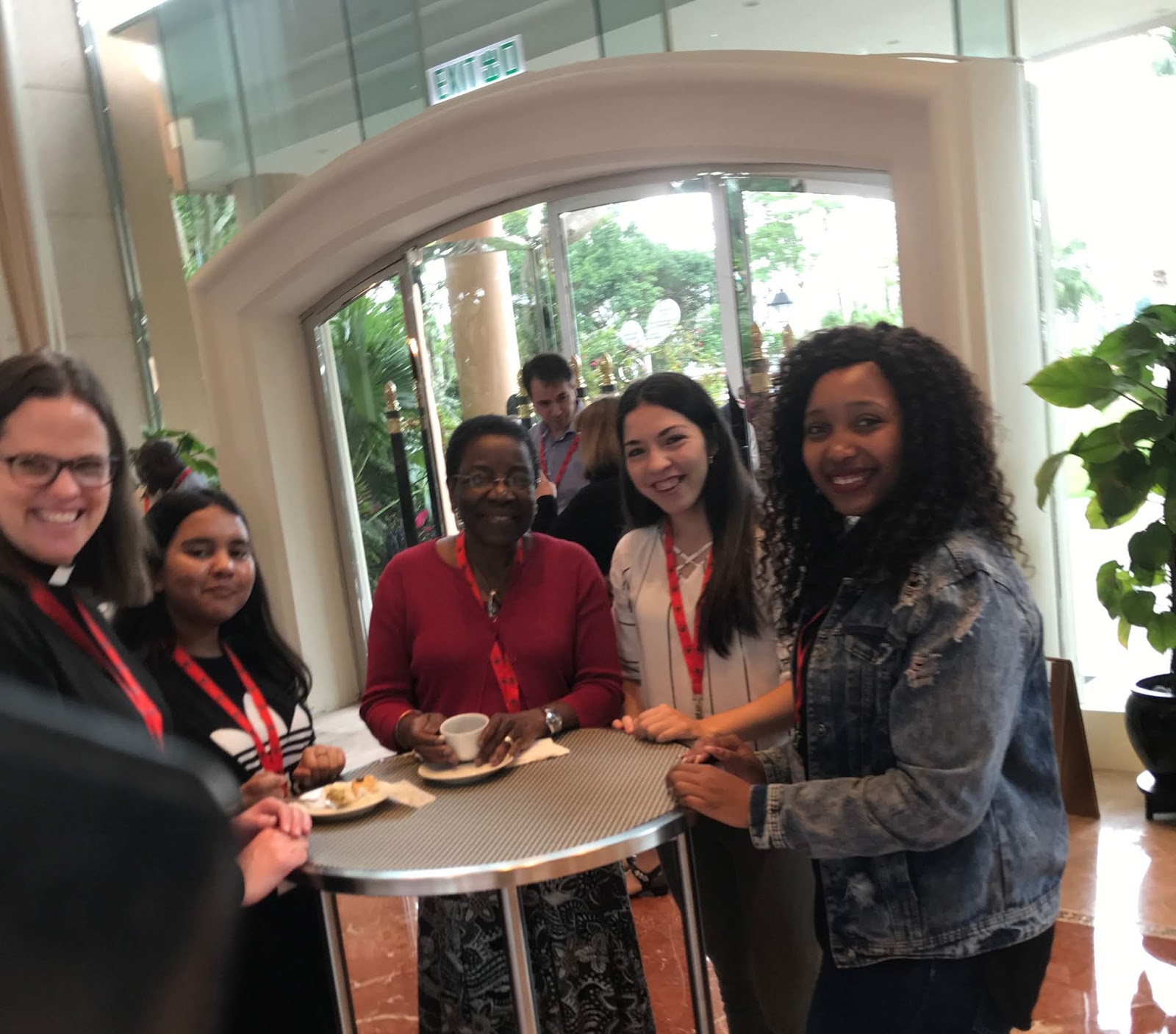
Basetsana Makena (centre) with Joyce Liundi and Dean Hosam Naoum. 
Archbishop Thabo wraps up his reporting on the 17th meeting of the Anglican Consultative Council in Hong Kong: 

The final closure of ACC-17 happened yesterday, Saturday.

In the morning, three new members were elected to the ACC's standing committee, a body which meets between the three-yearly sessions of the full ACC.

The three were Joyce Haji Liundi from Tanzania, Hosam Elias Naoum, Dean of St George’s Cathedral in Jerusalem, and our own Basetsana Makena, who represented Africa as one of the new regional youth members of the ACC. She is the first ever to be elected to this high office. Congratulations to all, especially Basetsana.

Otherwise, the final day's proceedings mainly concerned finance, preparations for next year's worldwide Lambeth Conference of bishops, and then resolutions.

A resolution calling for affirmation of those who feel discriminated against because of their sexuality, and calling for feedback on the section of Resolution 1.10 of the 1998 Lambeth Conference in which the Church committed itself to listening to gay and lesbian members, created good energy and a robust debate – a feature which had been missing until now. 

This was the best part: we argued, we shared real emotions and the issues briefly became real. It was a deeply touching and proud moment for me which was not “manicured”. The Archbishop of Canterbury and a team suggested an alternative motion to that originally presented, which was broad and referred to human dignity instead of human sexuality. This was a safe alternative and was passed without much debate. [See the text at the end of this report.]

The next motion, which called for a theological study of the identity and limits of the Anglican Communion because of the absence of Nigeria, Rwanda and Uganda from the Communion’s common life was defeated. My sense is that it was limited in scope and did not relate to the other “Instruments of Communion” (the Archbishop of Canterbury, the Lambeth Conference and the Primates' Meeting), nor did it take cognizance of what the Communion is currently engaged in. The resolution assumed that we had already concluded that the absence of these three Provinces was a theological matter, and passing it would have meant spending energy and time on Communion navel-gazing and internal problems instead of prioritizing the poor, the marginal etc.

We ended with a fanfare, a big reception and good byes, as Archbishop Paul Kwong of Hong Kong, the chair, declared that “ACC-17 is dissolved.” Then we held the first meeting of the new ACC standing committee, affirmed certain matters and agreed on September 19th as the date of the next standing committee meeting.

Later today, Sunday, we will go to different parishes. I go to St. Andrew's Church, Kowloon. Then we will go to the Cathedral for the final closing service and a meal afterwards. After that I have a meal and meeting with Paul Yung from Trinity Wall Street to talk about our building projects, following which I head for the airport.

Thank you for reading my prayers of recent days, bringing our Province to Hong Kong and the Communion to our Province. Thank you for your prayers for us. To South Africans, happy voting on Wednesday May 8th. In the coming days, pause to think: what values are key in making South Africa the best it could be in service to the poor? Then vote. 


Friday, 3 May 2019

Networks share the lifeblood of the Communion today


Archbishop Thabo blogs on his Friday at the Anglican Consultative Council meeting in Hong Kong:


Today we had a salad and were able to choose which presentations on the Anglican Communion's various networks to attend. (An authorised Network of the Communion connects Anglicans globally and creates a cluster of energy around a particular area of mission, ministry and concern.)

The sessions started with an input on communication in the Communion, raising the questions of what we communicate and why, after which we viewed a video on what networks are and what they do. 

This was followed in turn by a video on our response to the cyclones in Mozambique, made from Bishopscourt through the help of the Revd Rachel Mash of Green Anglicans and Frank Molteno of St George's Cathedral in Cape Town, which you can see below and on our Facebook page.

Then I joined the session of the International Anglican Women's Network, followed by the Youth Network and lastly the Anglican Church Planting Network. (See photos below the video.) Amazing work is done through these, showing that even when we disagree on some issues, at the heart of the Communion we are all involved in God‘s mission and as his broken body we are doing all through his grace.

Later we passed resolutions and I was moved to pray in isiXhosa when I felt the love and deep concern ACC members had for those countries affected by natural disasters or which were in conflict. I remembered and celebrated why am an Anglican – because of our ability to recall that even as the broken body of Christ, the Communion is called to offer others who are broken to God in Jesus Christ so that we are all healed.

This evening I will swim, have dinner and just enjoy the view from my room as I connect the dots. (Also below, see where we are staying.) And talking about the Health Network, I am sending my prayers to Bishop Adam Taaso of Lesotho, who was admitted to hospital yesterday. We wish him a speedy recovery. 


Thursday, 2 May 2019

Archbishops face a "grilling" at ACC-17

Archbishop Thabo continues his account from Hong Kong on the work done on Wednesday and Thursday by the Anglican Consultative Council: 

In further sessions, we heard a report from the Communion's Safe Church Network, which was set up to develop guidelines to enhance the safety of all persons in the church, especially children, young people and vulnerable adults.

Though time was limited, we started digging deeper into the regrettable pain of past and present abuses in the church, hearing voices from Africa, Europe, Asia and the Pacific. The discussion has been reframed to recognise that the abuses have hurt and negatively affected the mission of the church and the imperatives of the Gospel. The key development is that we have received guidelines, liturgy and a resolution on how we can move together to make the church safe and inclusive.

We then listened to an intervention and study commissioned by the Church of England called “Living in Love and Faith,” which is intended to provide Christian teaching and learning about human identity, sexuality and marriage. This is work in progress.

Before dinner, I again went for a swim to keep up with my exercise regimen. The meals are too good and one cannot do without physical activity as well – after all, physical activity is also part of my spiritual and prayer life. Sea bass is my favorite fish and today I had sea bass with veggies for dinner. (I am careful about sharing my favorite meals publicly. In one diocese, I foolishly did that and almost every parish responded by preparing it abundantly until I announced that I was off that. So sea bass is my favorite only as a treat and when I say so!)

At an after-dinner session, we had an hour-long event called “grilling the Archbishop” in which we could ask Archbishop Justin anything we liked, from what made him happy or sad to decisions about Lambeth, Brexit, his prayer life, Donald Trump and his vision for the church in 25 years, including what his prayer needs were. This was useful, as it eased the frustrations of working in a highly-structured ACC meeting, allowing some informality and including voices that would otherwise not be heard.

On Thursday, there was time for photos, of the whole meeting, the Standing Committee, the Primates on the Standing Committee and of the tables around which we are grouped. If you scroll down below the video which follows, you can see the community I have spent more time with than anyone else here, in Bible study and group work at Table 3, including ACC members from South Sudan, Singapore, Tanzania, Australia, Spain and Chile (two people from each) as well as Archbishop Josiah Idowu-Fearon, the Secretary General.

We also listened to theological feedback, of which the graphic - also below the video - gives you a flavour, and I joined Archbishop Justin and Bishop Jane Alexander, the Bishop of Edmonton in Canada, to face a grilling from a panel of Anglican Consultative Council youth members. That's the photo you see at the top of this entry, and the video which follows records the session.


Wednesday, 1 May 2019

ACC-17 focuses on ecumenical relations with WCC, Reformed and Catholic churches

Archbishop Thabo blogs on proceedings during the third day of the 17th meeting of the worldwide Anglican Consultative Council (ACC-17), being held in Hong Kong: 

We are halfway through ACC-17. Today, besides the rhythm of worship and Bible studies, we received reports and listened to greetings from ecumenical partners: His Holiness the Ecumenical Patriarch, Bartholomew, and (from left in the second photo below) the World Council of Churches General Secretary, Dr Olav Fykse Tveit, the General Secretary of the World Communion of Reformed Churches, the Revd Chris Ferguson, and Fr Tony Currer from the Pontifical Council for Christian Unity.

They all affirmed the Communion and appreciated our polity, especially our diversity and provisionality in polity as we continue walking together, seeking possible final answers to ecclesial and other questions.

We also adopted an enabling resolution that created a body within the Communion called the Reception Committee. This is a critical body which will receive ecumenical documents for the Communion instead of the Lambeth Conference, where time is at a premium. The committee will review the documents on behalf of, and with a select group from the ACC. This is an issue on which I have had robust discussion with the Communion’s Director of Unity, Faith and Order, Dr John Gibaut, who is sadly retiring.

Correction: The above report has been corrected since first published by clarifying that the Reception Committee will receive documents instead of the Lambeth Conference (not Lambeth Palace).


Tuesday, 30 April 2019

ACSA's youth rep does us proud in Hong Kong

Archbishop Thabo continues his reflections on the meeting of the Anglican Consultative Council being held in Hong Kong: 

The sessions at ACC-17 are progressing well and the daily rhythm is now established. Hong Kong's weather changes at any time – today is cloudy.

Today's main presentation is on intentional discipleship. In the photo you can see Fr Jerome Francis, our clergy rep to the ACC, and our youth rep, Ms Basetsana Makena, with me, and down the page you can see Basetsana doing us proud, interviewing the Anglican Communion Office directors of mission cluster group this afternoon. Below that you can see her at her meeting table and engaging others during tea breaks.

We listen to stories of faith around the globe and how, although there are challenges of money and lack of growth in some parts of the Communion, on the whole there is growth and excitement about mission in most provinces.

We also looked at a framework for catechesis for intentional discipleship in the Anglican Communion. Full of energy today, we were told that although we see longing, hurt and pain in the world, we are called to bring life, to change lives and to make disciples. The Holy Spirit will give us the heart of Jesus, the heart of discipleship, we also heard.

In the discussion of the Anglican Communion's five marks of mission, key issues raised were: a call for a prophetic voice on Argentina, where the number of women murdered is high; respect for the rights of refugees and migrants; and the challenges of climate change.


Monday, 29 April 2019

ACC-17 opens in Hong Kong - and an appeal to ACSA Dioceses

The ACSA delegation to ACC-17:
the Archbishop, Ms Louisa Mojela  and Canon Jerome Francis
Archbishop Thabo reports on the opening of the 17th meeting of the Anglican Consultative Council (ACC-17): 

#ACC-17 has officially opened with great fanfare and fine music, preaching and liturgy and worship. Archbishop Justin Welby of Canterbury preached powerfully, urging us to look beyond our bounds as we participate in God’s mission in the world.

Archbishop Paul Kwong, our gracious host and chair of the ACC standing committee, spoiled us with a reception of many courses, attended by numbers of people, including local leaders of other churches. A great day, full of energy although we went through it at a pace.

I could not help but note the plight of many domestic workers here in Hong Kong, who are on the whole migrants, sitting on the pavements of the city during their day off. They reflect the two diametrically opposed faces of Hong Kong.
With Sr. Patricia

Today we listened to various presentations and continued our Bible studies – on the road to Emmaus – and explored our theme of going deeper into international discipleship. The Secretary General, Archbishop Josiah Idowu-Fearon, also presented his report to ACC.

I ended the day with a swim as the gym was full this evening. I also had a long chat with Sister Patricia of the Community of the Holy Name, a delightful and brilliant religious. It really is my wish and hope that each diocese in our Province should have a religious order.

A choir from Hong Kong
ACSA lay delegate Louisa Mojela

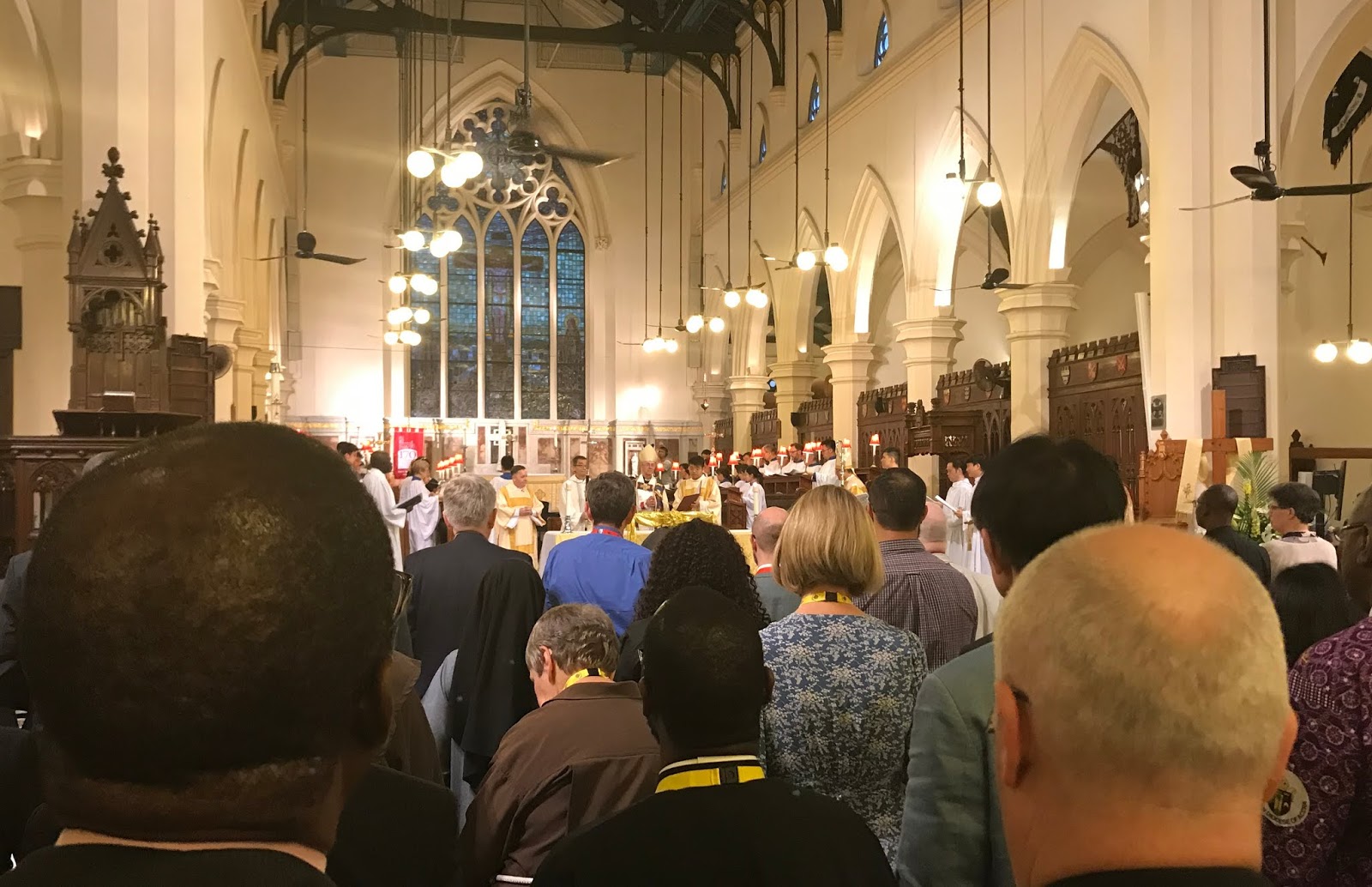
The opening service of ACC-17

Friday, 26 April 2019

Archbishop Thabo blogs from an Anglican meeting in Hong Kong

ACC-17 is being held at a hotel outside central Hong Kong. 
Archbishop Thabo blogs from a meeting of the Anglican Consultative Council (ACC). The council is one of the four "Instruments of Communion" of the world-wide Anglican family, the others being the Archbishop of Canterbury, the Lambeth Conference and the Primates' Meeting. The ACC is the only body which includes bishops, other clergy and lay representatives.

After a two-hour delay at OR Tambo, we have arrived safely. Louisa Mojela from our Province and I are both on the council's standing committee and so have a meeting tomorrow before ACC-17 starts. It is labelled ACC-17 because this is the 17th time the body has met. The first meeting took place in Kenya in 1971 and the last time it happened in South Africa was when ACC-9 met in Cape Town in 1993 during the archiepiscopate of Archbishop Desmond Tutu.

The ACC is the most representative Anglican body in the Communion and receives reports of commissions, networks and the Anglican Communion Office in London. It also passes resolutions on Mission, Ministry and Anglican polity. The last meeting was in Zambia in 2016.

Louisa Mojela is our lay representative, Canon Jerome Francis is the clergy rep and I represent the episcopate. Louisa's and my terms both end now, and Canon Jerome has another three years. This time round, we will be joined by a youth rep, the Provincial Executive Officer, the Ven Horace Arenz, who will represent us on matters of administration, and Canon Rachel Mash of Green Anglicans, who will represent us on environmental matters.

It is warm here and it drizzled just a bit when I took my walk after dinner this afternoon. We have a full programme and ask for your prayers for our Province's delegation and everyone meeting here.

Monday, 18 April 2016

Wrapping up ACC-16 in Lusaka

Archbishop Thabo wraps up his thoughts on the 16th meeting of the Anglican Consultative Council, which ends in Lusaka on Tuesday:

After burning the “midnight oil” in the ACC-16 resolutions committee last night, the resolutions were passed today, except one calling for the fifth mark of mission, concerning the integrity of creation, to be included as the fifth instrument of communion. The presentations were short and well-researched. 

I am a bit sleepy today and dozed off from time to time. After the resolutions were completed, and following evening prayers I attended my first meeting of the standing committee (which comprises seven members elected by the ACC and five who are members of the Primates' standing committee). We have a young team with a good geographic spread. We proposed that some of our meetings, including evaluating this ACC, will be convened electronically. I am delighted about this—given the nature of our vocation, one less meeting is a blessing.

Today is the anniversary of Zimbabwe's liberation. We congratulated our small group member, Arthur from Zimbabwe. The media headlines here in Lusaka so far have covered the church and politics extensively, the church here being much more in the news than at home. Election fever is in the air as various parties and individuals engage in politicking ahead of the polls in August.

I will soon return to our campaigning climate in South Africa, leading the Electoral Code of Conduct Observer Commission (ECCOC) as I often do in election season. My former high school teacher and later my tutor at Wits, a cabinet member, once warned me, “Arch, at election time, stay out of way, otherwise the power of the Oshkosh engine will  crush you.” She meant my actions and positions should be that of eagles' wings, carrying the country and everyone contesting the election as belonging to one family and rebuking each fairly.
Bishop Tengatenga (Photo: ACNS)

 After supper this evening, I sat with Bishop James Tengatenga, originally from Malawi, the outgoing chair of the ACC, who has just finished 14 years in the ACC. We shared deeply, his story being in the nature of a debriefing after his 14 years of service on the ACC. I thanked God for all he offered in service to this Communion. 
 
We end ACC tomorrow and travel home on Wednesday, so this is my last note. I pray that we will continue to hold each other under our wings as we work together in service to God in the world.  God be with you till we meet again.


Wednesday, 13 April 2016

What does 'gleaning' mean today? - Blogging from ACC-16

At our Tuesday Bible study, on Ruth chapter 2, we spent time looking at “gleaning” and the modern-day equivalents of collecting and using the leftover grain after the harvest. We discussed church feeding schemes, government social grants, cooperative social responsibility and city planning that is sensitive to parks and open spaces. Without discounting any of these, we considered how such schemes can be corrupted.
ACSA at ACC-16: Louisa Mojela, Abp Thabo, Abp Welby, Jerome Francis

In following the return of Ruth and Naomi to Naomi's homeland, we also discussed and shared the experiences of “returnees” from exile, or from failed ventures, and how it is often difficult emotionally, spiritually and psychologically to return and start life all over again.

In other sessions we received messages from the Lutheran World Federation and the Vatican's Pontifical Council for Promoting Christian Unity, and also met in small groups around our tables.

What I took away from the Pontifical Council's message is that living in communion is about care and concern for the well being of each other: that there is no such thing as the Anglican Communion for Anglicans; we all belong to Christ by virtue of our baptism and our decisions or lack thereof have broader consequences for all.

The ACC's financial report reminded me that mission and belonging is costly, that the staff reports I applauded must be funded and that the Communion and provinces, as well as dioceses and parishes, need to prioritise. The Compass Rose Society, the international group of Anglicans who help the Communion, needs to be complimented for its financial support of the Communion, the Archbishop of Canterbury's ministry and, as some of you know, our E-Reader project and the Diocese of the Highveld. Those from our Province who can join the Compass Rose Society, please do so and help our beloved Communion. We have our own financial challenges but I invite you also to contribute to something bigger than ourselves.

The small groups gathered for further discussion of the theme of ACC-16, “intentional discipleship”. Based on the staff reports, the groups are generating resolutions for possible adoption next week.

After the last Lambeth Conference's group photo, which involves hundreds of participants, the photos we took here – of the whole ACC-16 group, and of each Province's reps with Archbishop Justin – were no longer daunting, and went smoothly.

After a glitch – as a result of me getting times wrong after a siesta! – the ACSA team had time with South Africa's High Commissioner in Zambia, Ms Sikose Mji, and she will take me on Friday to the graves of South African exiles, for which I am grateful.

Last night we were hosted by parishes in the Diocese of Lusaka, joined by churchwardens of the parishes around the diocese. We were treated to local food, such as mopani worm, cassava, morogo, pap, fish heads and many other delicacies. It was a relaxed evening, with a choir entertaining us and a few mozzies feasting on my legs.

As I end this reflection, the fate of the miners trapped at Lily Mine in Mpumalanga is piercing my heart. I pray that by God's grace they, just like the miners trapped in Chile some years ago, might still be alive. I am not only lamenting them, but writing to those on my staff who handle public policy, the media and my socio-economic vocation, to assist me in taking this up at the highest possible level. Finally, I focus on the murder on the Wild Coast of Sikhosiphi “Bazooka” Rhadebe, the activist who was trying to stop the mining of titanium on the coastal dunes at Xolobeni. May God's abundant mercy and care continue to protect us even as we care for his earth and each other.

Monday, 11 April 2016

'God shone' at Lusaka Cathedral - Blogging from ACC-16

Photo: Green Anglicans
The rain heard our prayers for Sunday. As the opening Mass was held outdoors, it could have placed a dampener on the service but it held off.

Words can't describe the beauty of the service held outside the Cathedral – the various attires and vestments, and people of all ages. Green Anglicans have posted pictures which give a glimpse of this beauty. It was good to see Rachel Mach and some of the young Green Anglicans from our Province there.

I can only sum up the glorious Mass by saying, “This is the day of the Lord and we rejoiced in it.” From where the Primates sat, we saw tent after tent filled with people. The series of processions were an Anglican pageant at its best, led by various bands and servers. I was tempted to say those verses in Revelation, “who are these, robed in white...” After an hour of well-executed processions, four and more if the many bands are included, the Mass began.

The ululating and applause at various parts of the Archbishop of Canterbury's sermon and the speech by President Edgar Lungu characterised the day. I lost count of how many different choirs sang; we experienced a variety of beautiful song and dance. I love Anglican liturgy, it was what drew me to the ordained ministry, and the flow enabled by its structure held everything together, including the song, the dancing and the speeches. God shone.

Photo: Ian T Douglas
Reflecting on the lessons, and the context of Britain, Zambia and the global church, Archbishop Justin reminded us of the righteousness of the God who calls us to go into the world, not to flatter the strong but to serve among the poor and weak. We were to go out in joy and tell the story of Jesus and his saving love.

After five hours, we finally sat down for lunch. As President Lungu left, I spotted one of my favourite leaders, Zambia's founding president, Kenneth Kaunda. I managed to stand to shake his hand, thanking him for his courageous leadership that led to our liberation in South Africa. He has aged and is visibly bent now.

The leak of the Panama Papers has been on my mind and I hope to follow how the British Parliament will deal with Prime Minister Cameron's  acknowledgement that he held offshore investments. I also want to learn what the resignation of Iceland's Prime Minister means. This learning is key to our public theology, as we in South Africa hold President Zuma to account. What can we learn from other nations on kingdom values and political values?

I had a long siesta and much-needed break after the service, recalling the prayer I said during the Mass:

Photo: Green Anglicans
“Righteous Lord, thank you for the fellowship and ministry that we share together as your servants. Give us strength, humility, wisdom and courage to share with all your story of peace with justice. Enable us to speak where others fear to speak, to walk where others dare not tread and to act where others do not. 

Thank you Lord, for our unity in Christ. Give us joy and determination to maintain this unity of purpose within our Anglican Communion. Make us celebrate our diversity even as we continue in intentional discipleship. 

We pray for all Anglican Communion networks and for countries where the Communion is present, especially countries in conflict. Give us renewed courage to radiate your love, care and  compassion and to seek your righteousness. Lord in your mercy – Hear our prayer.”


Sunday, 10 April 2016

'We shall overcome' - blogging from ACC-16

A pattern is forming at ACC-16, where I am finding my table in Holy Cross Cathedral – around which we meet in groups – a source of security. Here we open up and share with one another the missional challenges and opportunities in our different Provinces.

I share what you all know well by now at home, our Provincial Vision and Mission statement, which is that “Anglicans ACT”, meaning that the Anglican community in Southern Africa seeks to be:

The sun breaks through in Lusaka. 
Anchored in the love of Christ,
Committed to God's Mission, and
Transformed by the Holy Spirit.

Within that, I name three key areas which are close to my heart and in line with the Communion's five marks of mission.

The first is education, or the nurture and protection of the young, and I share my pride in the fact we have now officially opened the Vuleka Archbishop Thabo Makgoba School for Boys in Sophiatown, and we will open the Maboee Archbishop High School in Lesotho this month also.

The second area I share is socio-economic concerns, how we have started courageous conversations with mining communities in our region, and how we will use this partnership not only in raising economic justice issues and ethical investing, but will partner too in building schools and other community projects.

I also highlight, as you would expect, the new struggle in South Africa, which I explain briefly as as a prophetic call and pastoral longing for equality of opportunity in a democratic nation. This priority is in line with the mark of mission, “To transform unjust structures of society...” I echo what someone said: “Let's do God, thank God and talk God”.

Lastly, I share our concern for the environment and Matthew Davies from the Episcopal News Service plays for us a video clip which you can see at the end of this entry. The stories from other Provinces were edifying and moving, and I feel encouraged when I hear I am not alone in this journey but that our wider family, including ecumenical partners, experiences the same joys and challenges as we do.

Meeting tables in Holy Cross Cathedral.
Then we listened to the Old Catholics, the Global Christian Forum and CAPA to hear stories of what God is up to in and beyond the Anglican family, and were fed and stretched by these accounts. Later in the day, I had the opportunity as chair of the resolutions committee to introduce my team and explain the procedure to a plenary session.

As you hopefully know by now, in my quest as archbishop of seeking peace with justice, the key values I try to promote are equality of opportunity, acting with courage, and collaboration, stressing “we” as opposed to “me”. Theologically these have focussed on “abundant life” – what does the common good look like, or systemically what is the incarnation?

The stories and sharing from Bible studies here, as well as listening to the new account of Archbishop Justin's paternity reinforce my call, and the need to act with courage in our lives: courage not as the absence of fear but as a willingness to take risks because you are cooperating with God's plan of liberation. At one stage, I quietly sang to myself that song of liberation and courage: “We shall overcome; Deep in my heart, I do believe; That we shall overcome some day.”

We had a great evening last night, with an official welcome from our host, Archbishop Albert Chama, and Vice President Inonge Wina. There were about 800 hundred of us present, including clergy and their spouses from the Central African Province, bishops and ACC members. We had a relaxed time and some fine speeches.

This morning, the sun is trying its best to shine on us, and we have an opening Eucharist in the grounds of the Cathedral.

†Thabo Cape Town


Saturday, 9 April 2016

Blogging from Lusaka - ACC-16 "walks together"

The clouds forming on Thursday did burst, and we had rain yesterday. It's still cloudy and, thank God, not hot.

We were warmly welcomed by the Diocese of Lusaka and the ACC was duly constituted. We are seated in round tables and will remain so throughout the meeting. I always enjoy the real expression of communion in the diversity of small groups - I am in a group with Irish, Tanzanian, Cypriot, Zimbabwean, West Indian and a Malawian representative now residing in the USA.

We started with a beautifully crafted Bible study on the book of Ruth. I call it an inter-racial, inter-cultural, cross-cultural and cross-class account of the foundation of God's elect. We share deeply and find each other and God in our sharing.

Archbishop Justin gave a brilliant and theologically-balanced account of the Primates Meeting in January and explains the concept of “walking together”. His report was accepted by ACC-16, confirming that we will walk together, with our blemishes and all.
Archbishop Justin speaks.


The cathedral choir soaked our Mass with their beautiful voices as the filled the huge Holy Cross Cathedral with melody. We end the day with an orientation of how ACC works. As with most elective assemblies and synods at home, there are more and more new people - it's my third ACC and I felt old when almost two-thirds of people raised their hands to indicate that it's their first ACC. Hence orientation was key.

We say Evening Prayer together and walk to our hotels. Please continue to soak us in prayer: pray for the West Indies representatives, prevented by a cyclone from attending, and also those who have decided not to come. We belong with each other in this reformed Catholic, Anglican family.


†Thabo Cape Town

Friday, 8 April 2016

Archbishop Thabo blogs from Lusaka on ACC-16


The Anglican Consultative Council begins its 16th meeting (ACC-16) in Lusaka today, and Archbishop Thabo is heading ACSA's delegation to the sessions. The ACC is one of four “instruments of Communion” for the worldwide Anglican Church, and the only one in which laity and clergy other than bishops are represented. Every Province in the Communion is represented by a bishop, a clergyperson and a layperson. The other “instruments” are the Archbishop of Canterbury, the Lambeth Conference and the Primates Meeting.

I have arrived in Zambia for ACC-16 and I will try, God willing, to update our Province on what happens here through brief reflections. There will be no Ad Laos or Good Hope articles from me this month.

Landing in Lusaka, I felt nostalgic. My first cousin, Peter Makgoba, spent time here during the armed struggle against apartheid. In those says, Lusaka was the “head office” of hope for liberation for most South Africans. When we were students, any message from Lusaka came with the feeling that the sunspot of apartheid would disappear.

This hope, excitement and dream is fading away now and my earnest prayer is this that this is temporary; that we will once again rise above this period in our country, and rekindle hope and energy for a future in which we all share and our dignity is restored. We dare not, I pray we will not, have another Marikana. We must not have another Marikana.

I came here following two two beautiful and hope-inspiring days in Joburg. First came the launch of the Archbishop's Vuleka boys' school in Sophiatown, in line with our missional priority to nurture the young. The Anglican Board of Education has taken our aspiration and delineated three practical areas for action:
  • To support existing church schools,
  • To galvanize parish and community involvement in schools, including schools run by governments, and
  • To establish high-quality, accessible Christian schools.
On the second day, I went back to my alma mater, Wits University, and asked my fellow alumni to be part of the solution we want to see for students who cannot afford to pay their fees. We established the South African Student Solidarity Foundation for Education (SASSFE), and already have pledges for donations. Our aim is to respond in tangible ways to ensure access to for poor students.

Here in Zambia, they had elections last year and are scheduled to hold them again in August. I am told President Lunga will celebrate them with fanfare. It's a great example.


The ACC's Standing Committee met on Wednesday and Thursday. I couldn't join them because when I was elected to serve this year, the events in Johannesburg had already been planned. Many ACC members are arriving and the mood of the Communion is forming like the clouds outside – which may bring rain.

I look forward to our time here, learning from others around the globe and experiencing personal growth. The Revd Jerome Francis from Cape Town is our clerical representative and Louisa Mojela of Gauteng, who also serves on the ACC's Standing Committee, is our lay rep.

God bless you,

†Thabo Cape Town

Tuesday, 11 December 2012

To the Laos - To the People of God - Advent 2012

Dear People of God

‘Come, thou long-expected Jesus’ is a well-known Advent hymn which goes on to describe Jesus as ‘hope of all the earth … desire of every nation … joy of every longing heart.’ Advent has been described as a ‘season of desire’. It is a time for us to listen to the yearnings of our hearts, our souls: our profound longing for Jesus to come with the fullness of his redemption, into our lives and the situations around us. It is a time for giving voice, in prayer, to the ache we feel for every person, every circumstance, which needs the compassionate, loving, healing, touch of our Lord and Saviour. It is also a time for giving thanks for all that we have seen of God at work in our lives, and fervently asking that he may be present in ever greater abundance.

I have been pondering this, particularly as I look back on November, which was a truly remarkable month, diverse and full. When it began, I was in New Zealand, participating in the Anglican Consultative Council, with other Anglicans, nearly bishops, clergy and laity from around the world. We shared deeply together around all aspects of the Anglican Communion’s ministry and mission – often from very different perspectives, but in a way that I felt was healing to relationships. Please pray that it may be a turning point for moving ahead united in Christ, even where we do not wholly agree; and especially that the ‘Continuing Indaba’ and ‘Bible in the life of the Church’ projects will keep on bearing fruit. Please pray too for God to further guide and bless major issues which we tackled: the environment; violence especially against women and children, and churches as places of safety; and Christian witness in a multi-religious world. There is much here that we can pick up on, to enrich our own lives, and equip us in our own calling to be faithful witnesses to the good news of Jesus Christ. You can find out more through the links at www.anglicancommunion.org

It was the last Anglican gathering with our beloved Archbishop Rowan before he steps down and returns to academic life. My heart was full to overflowing – and so were many others – as he gave his final address to us. We give thanks for his remarkable servant ministry over the difficult times of the last decade, and ask God to bless him, his wife Jane and family, in their move, and to continue to make him a blessing to so many others. In the same vein, we thank God for Bishop Justin Welby, who will succeed him in the new year, and pray for him, together with his wife Caroline and their family, as he prepares to take on the great responsibilities that lie ahead. I am reminded of the ‘Charge’ in our service of ordination and consecration of a bishop, which says ‘No one is sufficient for these things’ but then says ‘May the God who makes us able ministers of his new covenant equip you with grace and give you his blessing and joy.’ This is surely what we long for, for the new ‘ABC’.

And I am sure it is our prayer also for our newest Bishop in Southern Africa, Bishop Ellinah Wamukoya, whom we consecrated in Swaziland with such joy on 17 November – the first Anglican woman in Africa to be made a Bishop! We rejoice with her and her diocese, and ask the ‘long-expected Jesus’ truly to be ‘Emmanuel’, God with her, and her clergy and people, as they go forward into this new chapter of life. We pray also for The Ven. Margaret Vertue, who will be consecrated Bishop of False Bay on 19 January; and the Revd Dintoe Stephen Letloenyane and Revd Stephen Moreo, who will be consecrated Bishop of the Free State and Bishop of Johannesburg, respectively, in two services in March.

As we thank God for, and pray for, those he calls forth as leaders, shepherd of his flock, in every generation, let us also pray for the Church of England, so traumatised by their long synodical processes around the consecration of women to the episcopate, and the failure of last month’s vote. May God give them light in their darkness (a powerful Advent theme), to show them his path ahead.

For our part, we are moving forward on the path we believe God has set before us, the path of our Vision, ‘Anglicans ACT’, which we celebrated in a service in St George’s Cathedral, Cape Town at the end of November. You can watch it on Youtube at http://www.youtube.com/watch?v=l5-9b7tWFFw, and copies are being made available via Dioceses on DVD. The various teams are making progress in their work – watch this space in the new year, as plans unfold for helping equip dioceses and parishes in our priority areas!

So, within the life of our church, at home, and globally, we have much to thank God for, even as we desire to grow more into the newness of life that is his promise. But when we turn our eyes to look at the world around, our yearning for God’s redemptive touch becomes much more urgent. In South Africa, we have had the tragedy of Marikana, now being investigated through the Commission of Inquiry headed by Judge Ian Farlam who is ACSA’s chancellor. All involved need our prayers. There is also the complex situation around farm workers’ salaries in the Western Cape, where we yearn for just living wages. We also anticipate the ANC conference in Mangaung from 16 to 21 December. With a vote on the ANC’s, and hence the country’s, presidency, it is of major importance to our future, and our ability overcome trends of corruption and self-interest among political leaders, and return to putting the needs of all citizens at the top of the agenda. Elsewhere around our Province, countries battle with consolidating democracy, with food shortages, with wise use of mineral resources, with the scourge of HIV and AIDS, and with the ongoing long slow struggle to overcome poverty and all its consequences.

Therefore, especially for those in South Africa for whom 16 December is the Day of Reconciliation, I am calling for a day of prayer and fasting. Let us not be afraid to pour out our hearts to God – bringing before him all our hopes and fears for our countries, all our yearnings and desires for his kingdom to come and his will be done among us. In Advent we look forward to God’s promise to reconcile all things in Christ to himself (Col 1:20); and we also recall how he has entrusted his ministry of reconciliation to us also – so let us make this a day truly of God’s Reconciliation.

Let us plead that we may know the fuller coming of Christ, ‘risen with healing in his wings’ within our nations and our communities, especially where there are divisions – whether of history, politics, economics, language or race, personality, or through some unhappy force of circumstance. Let us pray fervently that God will meet us in all our needs, in Jesus Christ, so that there may be good news for the poor, freedom for the oppressed, liberty for all who are afflicted (Lk 4:18). May those who walk in darkness find a new light dawning (Is 9:2), and may all of us have the wisdom, the courage, the commitment, to walk in the paths God lights before our feet (Ps119:104). May justice roll down like waters, and righteousness like an ever-flowing stream (Amos 5:24), and may God’s kingdom be found among us.

This Advent-tide, let us wholeheartedly pray for Jesus Christ to come to us, ‘Come, O come, Emmanuel!’

Yours in the service of Christ

+Thabo Cape Town

Tuesday, 6 November 2012

News from New Zealand - 10

Tuesday 6 November – The weather shifted from blue clear and warm sky, to wind and now showers. I could not stay to the end of today’s agenda, for an informative session this evening on witnessing in a multi faith context, as too much sneezing and a runny nose compelled me to go back to the hotel.

I am grateful for the dinner hosted on Monday night by tikanga Pakeha (the European ‘thread’ of the Anglican Church of Aotearoa, New Zealand and Polynesia). We enjoyed beautiful music by the diocesan school for girls’ choir. This morning we continued with our daily rhythm of worship, fellowship and work. Our business included discussion of the Continuing Indaba project. You can read more about it at http://continuingindaba.com/, and my own words about what the concept and practice of indaba might mean for the Communion, at http://continuingindaba.com/2012/06/15/indaba-and-scripture/. (There is also a link there to the longer address, from which these comments are taken, which I gave in 2010 to the annual conference of the USPG – now known as US.) The presentation and draft resolution raised a lively debate. This is exactly the approach Anglicans should take! Indaba does not remove robustness but instead aims to ensure a context in which we can trust one another and so allow ourselves to speak with this freedom and honesty, knowing that we all value each one’s opinion as we together seek the mind of Christ. As a result of this frank discussion, we agreed that the programme should continue.

We then heard a report on the Communion’s Communication work, and passed a resolution on this as well as another on the work of NIFCON (our inter-faith network). We also had some thorough discussions of the Instruments of Communion, and talked about the Anglican Covenant. Another task was to choose the ACC’s representatives to the Communion’s Standing Committee – we offer our congratulations to the six who were elected, who represent a good balance of laity and clergy, gender and geography. I am delighted that our own Louisa Mojela, attending her first ACC meeting, is among them. Louisa is a businesswoman, and a parishioner in the Diocese of Johannesburg. We wish her well, and assure her, and the others who were elected, of our prayers as they serve our global Communion at this highest level.

Tomorrow is our last day, and we will have the closing Eucharist and then begin our journey home. I will end my blogging tonight. Thank you for reading and for your feedback. I will incorporate tomorrow’s closing reflections into my monthly ‘To the Laos’ letter, in which I also aim to include comment on the resolutions agreed at ACC, and provide links to where you can find further information about our meeting, what we decided, and how we hope to take these decisions forward for the benefit of the whole Communion and each of its member Churches.

Till we meet again, may the road rise up to meet you, and may God hold you in the hollow of the palm of his hand and assure you of his love and protection on all your journeys. To all Kiwis, let me say a huge Thank You for your generosity and care of us all. May you continue to be a blessing to all.

Monday, 5 November 2012

News from New Zealand - 9

Monday 5 November - I do not do well with farewells. Today I kept humming quietly to myself the Lord’s Prayer, which was sung by the choir at St Paul’s Cathedral yesterday. It was sung in Maori, slowly and with deep meaning. I hummed this throughout the day as if protecting myself from what I knew was coming at Evening Prayer tonight. It was the last address by Rowan Williams, Archbishop of Canterbury, as President of the Anglican Consultative Council, at his last ACC meeting as Archbishop.

The moment arrived. We were all overcome by a welter of emotions. He spoke from the heart and it was hard. When he offered the blessing, my eyes were too heavy and my heart as well, and my ears could not hear the words.

Archbishop Rowan spoke about authority: about enabling, life-giving authority, and corrective, reactive, authority within the Communion. (You can read more detailed coverage of his address at http://www.anglicancommunion.org/acns/news.cfm/2012/11/5/ACNS5233, and follow the link to the audio-podcast that will soon be online.) I just wanted to record the sense of joy and gratitude for having had the privilege of having worked with him as the Archbishop of Canterbury, ever since I became bishop suffragan right through until now; and also to acknowledge the deep and heavy heart of saying good bye to him as Archbishop. I have been so enriched, and so touched, by listening to his reflections, both to the ‘pins in the skin’ that the office has inflicted on him, and equally to his sense of joy for having served; and his deep gratitude for, and acknowledgement of, the support of others and God's grace that has seen him through. He is a wonderful example to all in Christian leadership.

Let me just repeat the words I said in March, when we learnt that Archbishop Rowan would step down at the end of the year:
“My heart is very full at the news that Dr Rowan Williams will stand down at the end of this year. We in the Anglican Communion, and indeed the wider world, have been inordinately privileged to have such an able theologian and deeply spiritual thinker, as Archbishop of Canterbury over the last decade. He has exercised remarkable gospel-shaped leadership during tumultuous times for our Communion, in which his commitment to consensus seeking, rooted in his refusal to take quick and easy solutions that fail to address the more fundamental issues, has shown great courage and deeply profound rootedness in the faith to which we are called. Again and again he has returned us to the central questions of whose we are, and for whom we are to be – in loving, faithful, obedient, service of God, of God’s church, and of God’s world. I look forward to the fresh contribution he will be able to make in coming years to the Christian voice in the public space, as he moves to Cambridge.
“I personally, and we in the Anglican Church of Southern Africa, will miss him very much. He has been a great friend to us, and especially to me when I was first appointed Archbishop and learning the ropes. As Southern Africans we say he is ‘Truly Umtu’, someone who lives and embodies the fullness of ubuntu – that it is through others we find our own humanity, umuntu ngumuntu ngabantu. We wish him, his wife Jane, and children Rhiannon and Pip, great joy and blessing during the rest of their time at Lambeth Palace, and in the new chapter of life that lies ahead. They have the assurance of our fondest love and prayers in the coming months. “

Today that same love, those same prayers, for Rowan and Jane, are echoing in me deeply, and I know I shall continue to carry them in my heart and before God as I return home. Please join my prayers for these beloved servants of God.

Sunday, 4 November 2012

News from New Zealand - 8

Sunday 4 November - Yesterday I observed a Sabbath from writing. Sunday was a day for ACC members to have ‘Mission Encounters’: through worship, conversation and hospitality at the invitation of churches in Auckland and the wider Anglican Church in Aotearoa, New Zealand and Polynesia. So on Saturday evening I travelled from Auckland to Wellington on the southern tip of North Island, and stayed overnight with Tony and Susan Browne, delightful and hospitable hosts. They gave a great dinner, over which I enjoyed meeting some of their colleagues and friends.

On Sunday morning Canon Jenny Wilkens, the priest in charge, also gave me a warm welcome at St Paul’s Cathedral and showed me the ropes . The Cathedral is situated opposite the Houses of Parliament, rather like our St George’s Cathedral in Cape Town. I enjoyed preaching at both the 8am and 10am services today and appreciated the parish lunch afterwards. I shared a thirty minutes PowerPoint presentation about the life and mission of ACSA – I hope it will soon be available on our ACSA website, for you to see and comment on. It was fulfilling to hear the views of senior laity, committed to our church and wanting it to be relevant in its vocation and teachings about Christ, and its prophetic ministry in situations where there is no fairness and justice. It was a great time, and I enjoyed discussions about church and state, including with diplomats and former diplomats. I was particularly glad to meet South Africa's High Commissioner and Deputy High Commissioner to New Zealand at the 8am service.

The people were very warm. We may be different in locality, race, and other particulars, but the way we are able to share in worship underscores that the Anglican Communion family is one, among the baptized people of God. We share far more profound similarities than superficial differences. In both worship and fellowship this was evident.

Wellington is a beautiful city, though windy like Port Elizabeth in South Africa. The air strip is surrounded by water on both sides – it reminded me of landing at Port-au-Prince airport, when I visited Haiti after their terrible earthquake. We were all asked to bring back a picture from our Mission Encounter, and write 100 words about our experience for sharing with the ACC plenary on Monday. I took a photograph of the picturesque scene where North and South Islands almost meet, from the hill that overlooks Cook Strait – it is rather like Signal Hill overlooking Table Bay in Cape Town! It was a beautiful sight, and I am grateful to my hosts who took me for a tour after the service and lunch.

This afternoon I travelled back to Auckland and I will now have an early night to bed in readiness for our final week of work. As a preparation for coming down from this ‘mountain top experience’, I am starting to reflect on the weeks ahead, back in Southern Africa. Soon after I return, Lungi and I will go to Swaziland to consecrate our first woman bishop in the Province, Revd Ellinah Wamukoya. Pray for us, and for Ellinah as she takes this enormous responsibility of serving Christ in this new role.

Friday, 2 November 2012

News from New Zealand - 7

Friday 2 November - We have kept the same rhythm, day by day, and it finally feels that my – and most others’ – jet-lag has dissipated. This was evident in the energy levels during our plenary sessions today.

After our Bible Studies, we concluded our discussions on environment issues, with a session which I was privileged to facilitate. Afterwards we looked at the report on the Communion’s ‘Bible in the Life of the Church’ project. This is a helpful report and I encourage every Anglican to read it. You can learn more about it at http://www.aco.org/ministry/theological/bible/index.cfm, where there is a link to download the full report (20MB). I will post the link separately, and also make sure copies are available at COTT and in each diocesan office. The report looks at key principles of how we as Anglicans handle scripture. It is quite concerning that it concludes that the level of biblical literacy is not satisfactory. The motion ACC is considering on this has been sent back to the resolutions committee for further work. We then dealt with a report from NIFCON (Network for Inter-Faith Concerns) which reflects on Christian Zionism and suggests how Anglicans can approach this matter. There was a lot of energy and discussion around this report, and an appreciation that at least a study had been written on this matter.

Tonight we had a Polynesian dinner. We were again fed good food and entertained through cultural music and dance, as Archbishop Wilson read the creation story and pleaded for good stewardship and care for the environment. There are people already being displaced by the rising sea levels, and climatic change for them is no longer a theoretical debate but a life and death matter. It does not matter whether scientist have made wholly correct calibrations or how far the changes are natural and/or induced by human activity: the fact is that these changes are adversely affecting the Pacific Islanders. He made a strong plea through music, dance and story-telling, in a fun way which at the same time conveyed a serious message.

At lunchtime, I fielded a couple of questions from church reporters at the press conference on the same topic. One question I was asked was ‘What might a moral intervention by a Christian as opposed to a politician look like?’ What do you think?

I want to return to the themes that we discussed yesterday, on the topic of the environment, food, water and energy nexus. The thought of the Eucharist as bread, food, from heaven stayed with me throughout today. I asked the audience to think deeply about the relationship between the sacrament and the environmental crisis, and to reflect on food as Eucharist, water in baptism, and energy as the sacred space we worship in.

I just want to attempt some brief comments on receiving the Eucharist, as it is a practice I follow most weekdays with staff at Bishopscourt and almost every Sunday. I want to raise some questions for reflection, and I hope these will also help provoke your own reflections and questions. If you want to share these with me, I will value that.

There are many perspectives within Christian (and Anglican) tradition in which we have reflected on what it means to receive bread and wine as Jesus taught us to do in remembrance of him. As I said in a sermon recently, we might think of it as
- the Lord’s Supper – the foretaste of the heavenly wedding banquet of the lamb of God who takes away the sins of the world;
- or we might think of it as Communion – our being drawn into intimate closeness with our Lord and Saviour;
- or as Eucharist, which means ‘thanksgiving’ – a celebration of all Jesus Christ has done for us;
- or even as the Mass – being ‘sent’ into the world, so that having been fed and strengthened by all that Jesus Christ has won for us, we can share all this with the needy world around.

In fact, we probably ought to think of it as a combination of all of these! Furthermore, in the Eucharist, we share God's faithfulness to us, that whilst we are still sinners, he sends us a gift of life in this meal; he send us his Son, so that we can be touched by his life and be fed, nurtured, and strengthen for his service.

There isn’t room here even to attempt to give a full theological survey of the Eucharist here but I find the following Bible readings helpful as a start: Ex 12:1-14; Deut 8:2-3; Luke 22:7-20; John 6:51-58; 1 Cor 10:16-17 and 11:23-26.

This meal is provided by God, and therefore, although those that celebrate are fallible humans, this does not detract from the giver of the gift, nor from our being touched and healed by the gift. In our turn, we are called to ensure food security for all, as the Eucharist demonstrates it can be done.

One other point that I want to mention is very emotive. This when in church we are denied this holy food because of certain doctrinal positions (for example, Roman Catholic clergy are not permitted to give the Eucharist to Anglicans). Yet I understand the pain of the one that denies others, and will not for a second discount it. Another matter that I am flagging, is when because of some disagreement over approach or understanding with the priest, someone might ‘boycott’ the Eucharist. I need to reflect deeply on this, as I recall that when I was Bishop of Grahamstown, our bishops recalled students from the College of the Transfiguration, when they had boycotted the Eucharist because of a disagreement they had with college management. I just want to highlight these sensitive, stressful, matters, and ask the questions: Who are you boycotting? And what does this say about your understanding of the Eucharist, this gift of life, faithfully provided by God? What is your own understanding of the Mass? Would you stay away from receiving Communion because you have a grievance? Shouldn't partaking heal you and allow Jesus to touch you afresh and renew you, even as you go and discuss your qualms with whoever has offended you?

Here in New Zealand, we have been fed by strangers and they have become friends for life. God, who meets us in our sisters and brothers in Jesus Christ in the Mass, will faithfully invite us to be fed with these foods of life.

Thursday, 1 November 2012

News from New Zealand - 6

Thursday 1 November - Today I presided at the daily Mass at the cathedral for the delegates and others who attend our services. All Saints day is special for many people. We remember Saints as those who have gone before us and are exemplar to our faith journey, the ‘cloud of all witnesses’ before and around us. We also acknowledge (reflecting the language of St Paul’s letters) our potential to be Saints for those who will come after us. It is always a joyous occasion for my family as our daughter was born on this day; and, if we are together with my wife's school (DSG, in Grahamstown), we always get to sing that great hymn ‘For all the saints, who from their labours rest …

The Saints trod this earth before they were recalled by our Maker. Today we had an excursion, and in the bus we were told the long account of the issues of the Maori land, and of the pain of dislocation caused by the wars which were fought in this land. Our destination, for which we set off after the holy mysteries, was Te Kingitanga, the Maori King Movement, and its head, the monarch, His Majesty Tuheitia and his wife. He occupies a modest piece of land and palace. He warmly received us, and fed us well. His staff was happy to know that there was a team from South Africa and requested that we have a picture with the King and his wife under a protea tree which was planted by President Mandela when he visited them. It was an honour to make another connection with this land, seeing a protea tree doing well in this climate. It was even more special because it was planted by Madiba, son of the African soil, who was so commited to global peace with justice. As he said, in the famous words of his defence statement at the Rivonia Trial, repeated on his release, ‘I have fought against white domination, and I have fought against black domination. I have cherished the ideal of a democratic and free society in which all persons will live together in harmony with equal opportunities. It is an ideal which I hope to live for, and to see realised. But my Lord, if needs be, it is an ideal for which I am prepared to die.’ I was also reminded of other wise words of his, ‘Education is the most powerful weapon which you can use to change the world.’ I felt that Madiba’s values held true, as I heard of the Maori quest for land reparation, and sensed the yearning in the voices of our guide on the bus, and of the King’s staff.

This context, together with our drive along the longest river in New Zealand, which also enabled us to see the mountains in all their spring beauty, set the scene well for our discussions this evening. We ended the day with a public forum on the environment, chaired by our beloved Archbishop of Canterbury. As chair of the Anglican Communion Environmental Network, I served on our panel, alongside Bishop Apimeleki Qiliho of Fiji, and Anglican Alliance director Sally Keeble We looked at the nexus of food, energy, water and environmental crises, and agreed that tackling this complex interplay of factors needs moral courage by all Christians. We heard stories from the Pacific, Africa and other parts of the globe, and affirmed that we have a biblical mandate to ensure justice in any structures and systems that threaten to destroy the planet, our home. Equally we agreed that this is a human matter and needs a human response. There are practical steps that we can take as individual and collectively. These included using our theological tools and biblical knowledge to open discussions on the issues of environmental crisis, informing ourselves, acting in a manner that is aware that our resources are not limitless, and ensuring ethical investment .

In May last year, on attending a World Economic Summit Africa meeting, I wrote an article entitled, ‘Climate change is a moral imperative for all’, which still remains relevant today. You can read at http://archbishop.anglicanchurchsa.org/2011/05/climate-change-is-moral-imperative-for.html. We need both love and courage to advocate for good stewardship of our environment. Difficult question were raised tonight, such as why some are left so debilitatingly without water, food and energy whilst others have more than enough, and remain silent. What of the current world economic order as well as social order around our planet? We need clear, bold, and courageous voices that continue to speak up and speak out for the displaced, the poor and the hungry and also for creation.

Do surf the Anglican Communion Environment Network site for more information (http://acen.anglicancommunion.org/index.cfm). You might like to ask yourself, what are some of the environmental changes that are now evident on your context? What do you think ought to be done about these? May the cloud of witnesses that has gone before us join us as we seek peace with justice and harmony in this planet. May God grant the King justice and righteousness in all he does, and may indeed justice and peace kiss each other (Ps 85:10) as we faithfully restore our world back to God.

Finally, Happy Birthday to my daughter, Pabi who turned 13 today! Wow! May she and her children's children find a place to live and worship God, safely passed on from our generation.